HC-SR04 Ultrasonic Sensor Module – High-Precision Non-Contact Distance Measurement Radar
The HC-SR04 Ultrasonic Sensor is the industry-standard, ultra-reliable, and highly cost-effective contactless distance measurement sensor deployed extensively in robotics projects, automated smart vehicles, and drone landing frameworks across India. By emitting high-frequency acoustic sound waves and calculating their total flight echo return times, the HC-SR04 Ultrasonic Sensor provides developers with precise, real-time distance tracking completely unaffected by a target object’s physical color, transparency, or surface ambient lighting conditions.
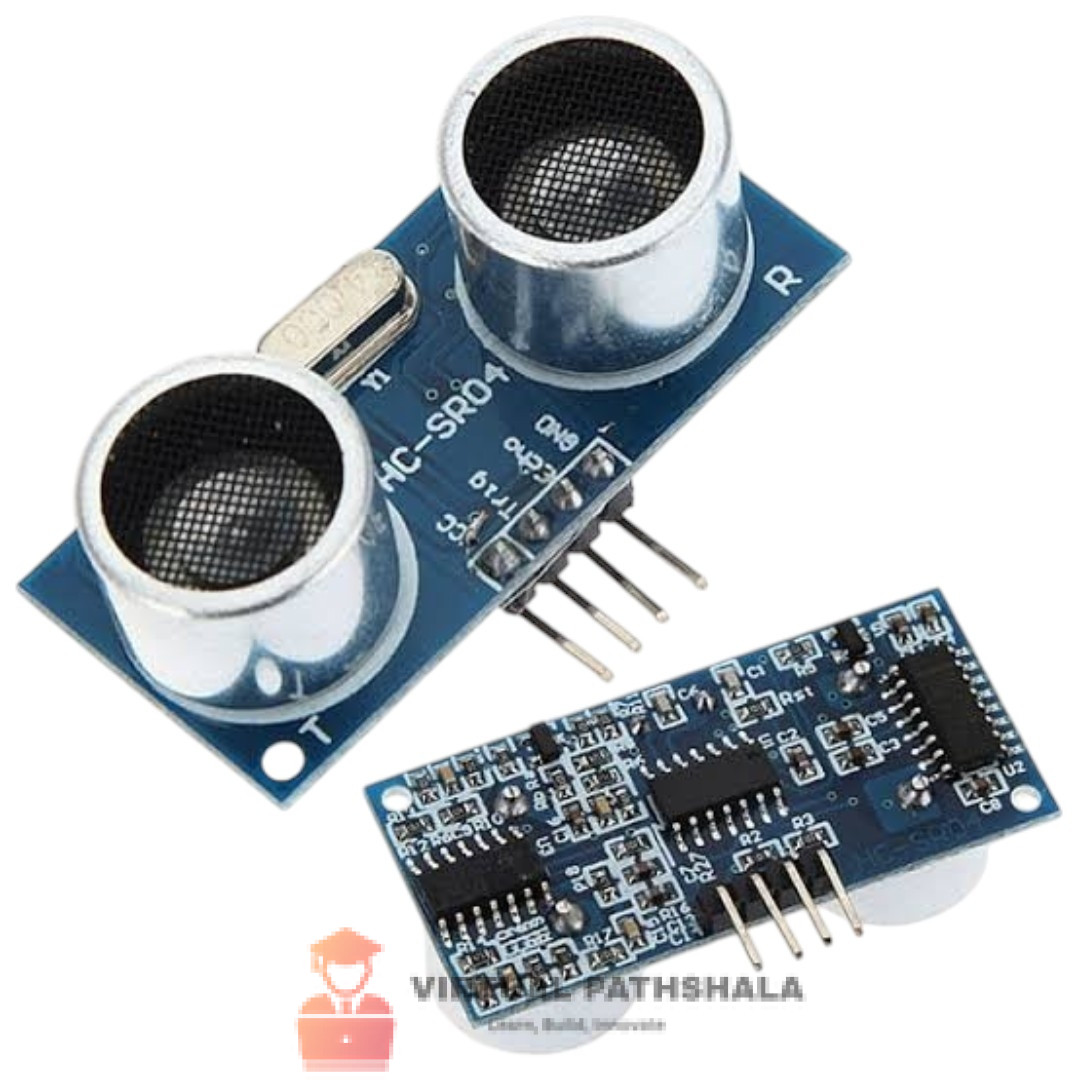
This pre-tested **HC-SR04 Module** breakout board integrates an ultrasonic transmitter transducer (marked with a T) alongside an ultrasonic receiver sensor crystal (marked with an R) onto a unified, high-quality blue PCB substrate. It operates on a standard 4-pin connector terminal arrangement, bypassing complicated analog signal processing configurations entirely. Expand your next autonomous machinery build by coupling this sensor link with our collection of Robotics Smart Car Chassis Kits and premium Microcontroller Board Ecosystems at VirtualPathshala.
Here is a clear view of the standard hardware layout you will be working with:
Why Engineers Choose the HC-SR04 Sensor Over Optical Alternatives
Basic optical infrared (IR) proximity sensors fail constantly because their distance approximations drift heavily depending on whether an obstacle is dark, light, or completely reflective. The HC-SR04 Ultrasonic Sensor systematically eliminates this weakness by using SONAR physics. Because sound waves bounce uniformly off solid barriers regardless of visual aesthetics, it computes pinpoint linear distance profiles spanning from 2cm up to 400cm with a stable, repeatable accuracy rating down to 3mm.
Key Features of the HC-SR04 Ultrasonic Sensor
1. High-Precision SONAR Transducer Array
The system operates by transmitting an ultrasonic burst pattern. When a micro-controller drives the Trigger pin high for 10 microseconds, the HC-SR04 Ultrasonic Sensor generates an internal 8-cycle burst of ultrasound energy at 40 kHz. This high acoustic pitch sits completely outside the hearing spectrum of human ears, preventing annoying field noises during operation.
2. Simple 4-Pin Hardware Interfacing Standard
The sensor completely lowers integration friction by offering an explicit, non-overlapping 4-pin physical terminal layout: VCC (5V Power Input), Trig (Signal Trigger Input), Echo (Pulse Width Output), and GND (System Ground). This makes tracking obstacle boundaries as simple as timing a basic digital pulse length using internal microcontroller timer registers.
3. Seamless Low-Overhead Distance Math
Calculating real-time physical spacing from the Echo pulse duration requires no complex mathematical derivations or heavy calculus code processing stacks. Since sound travels through standard sea-level atmosphere at approximately 340 meters per second, developers can resolve distance in centimeters inside their basic script loops using a straightforward, lightning-fast formula:
$$\text{Distance (cm)} = \frac{\text{Echo High Time ($\mu$s)} \times 0.034}{2}$$
4. Comprehensive Microcontroller & SDK Ecosystem Universality
Thanks to its industry-wide adoption, the HC-SR04 Ultrasonic Sensor features exhaustive, ready-made driver library resources across virtually every active engineering development ecosystem:
- ✅ Arduino IDE – Native plug-and-play via the popular NewPing library
- ✅ Raspberry Pi Python (RPi.GPIO) – Simple time-interval measuring scripts
- ✅ ESP32 / ESP8266 – Flawless compatibility (requires simple 5V-to-3.3V resistor dividers on Echo lines)
- ✅ STM32 & Pixhawk Flight Boards – Dedicated sonar landing altimeter inputs
5. Minimal Power Draw Profile
Operating efficiently within battery-restricted smart car setups, the sensor handles tasks without putting heavy strains on power reserves. Its active operational current hovers at a lean 15mA typical, and drops down to sub-milliamp levels when idling between trigger requests, enabling prolonged field performance.
HC-SR04 Ultrasonic Sensor – Full Technical Specifications
| Sensor Performance Vector |
Technical Specification Parameters |
| Electrical Characteristics |
|
| Operating Input Voltage |
5V DC Regulated Voltage Line |
| Static Quiescent Current Draw |
< 2 mA Standby Current |
| Active Operating Current Peak |
15 mA Continuous Working Current |
| Sensor Interface Pins |
4-Pin Layout (VCC, Trig, Echo, GND) |
| Sensing Radar Performance |
|
| Acoustic Operating Frequency |
40 kHz Focused Sound Beam |
| Effective Distance Sensing Range |
2 cm to 400 cm Linear Measuring Window |
| Absolute Distance Accuracy Resolution |
3 mm High Precision Target Matrix |
| Sensing Aperture Cone Angle |
< 15 Degrees Effective Measuring Field |
| Trigger Signal Requirement Input |
10 microsecond High TTL Pulse Drive Line |
| Output Signal Format Pulse |
TTL Echo Pulse Output (Duration proportional to distance) |
| Physical Structure |
|
| Sensor Form Factor Size |
45 × 20 × 15 mm Core Assembly Dimensions |
| Net Sensor Unit Weight |
8.5 Grams Ultra-Light Build |
What Is Included inside the Package
- ✅ 1× Tested HC-SR04 Ultrasonic Distance Sensor Breakthrough Module
Frequently Asked Questions – HC-SR04 Ultrasonic Sensor
Why does my HC-SR04 report a constant zero or out-of-range value?
This behavior typically stem from two sources. First, ensure your trigger cycle loop is issuing a full 10-microsecond high TTL wave to wake the transmission crystal. Second, if your obstacle is soft (like heavy fabric, wool, or thick sponges), it will absorb the 40 kHz sound wave energy rather than bouncing it back, meaning the Echo pin will time out waiting for a return wave.
Can I safely connect the HC-SR04 directly to a 3.3V ESP32 or Raspberry Pi?
You can safely drive the sensor’s Trigger input pin using a 3.3V logic signal from those boards. However, the Echo return pin pushes out a full 5V signal wave when high. To shield your 3.3V microcontrollers from over-voltage strain, run a basic 2-resistor voltage divider (e.g., a 1K ohm and a 2K ohm resistor pair) along the Echo line to scale that output safely down to 3.3V.
What happens if an obstacle sits closer than 2cm?
The **HC-SR04 Ultrasonic Sensor** possesses a physical physical structural dead-zone restriction below 2cm. Sound waves bounce back so rapidly within that tiny physical gap that the receiver crystal cannot switch states fast enough to isolate the echo. Any targets situated inside this 2cm margin will report highly erratic, inaccurate distance values.
Order Your HC-SR04 Distance Sensor Online Today
Get your hands on the industry’s ultimate non-contact range finder to power your obstacle avoidance rovers, automated liquid level controllers, or drone landing sensors. Delivered with fast shipping networks and proper tax invoices throughout India via VirtualPathshala. For official hardware data books, step-by-step connection layouts, and open-source software libraries, please visit the Official Component101 HC-SR04 Documentation Center.






Reviews
Clear filtersThere are no reviews yet.