MAX30100 Pulse Oximeter Sensor Module – High-Precision Integrated Heart-Rate and Photoplethysmography (PPG) Board
The MAX30100 Pulse Oximeter Sensor module is an incredibly sophisticated, low-overhead, and high-precision integrated biomedical analytics board widely deployed across India for wearable fitness trackers, portable patient health monitors, and academic bio-sensing research projects. By combining high-intensity internal LEDs and a sensitive photodetector, the MAX30100 Pulse Oximeter Sensor measures blood oxygen saturation ($SpO_2$) and pulse rates using photoplethysmography (PPG) physics. It tracks raw arterial absorption spectra, giving microcontrollers instantaneous access to vital signs data through a clean digital serial stream.
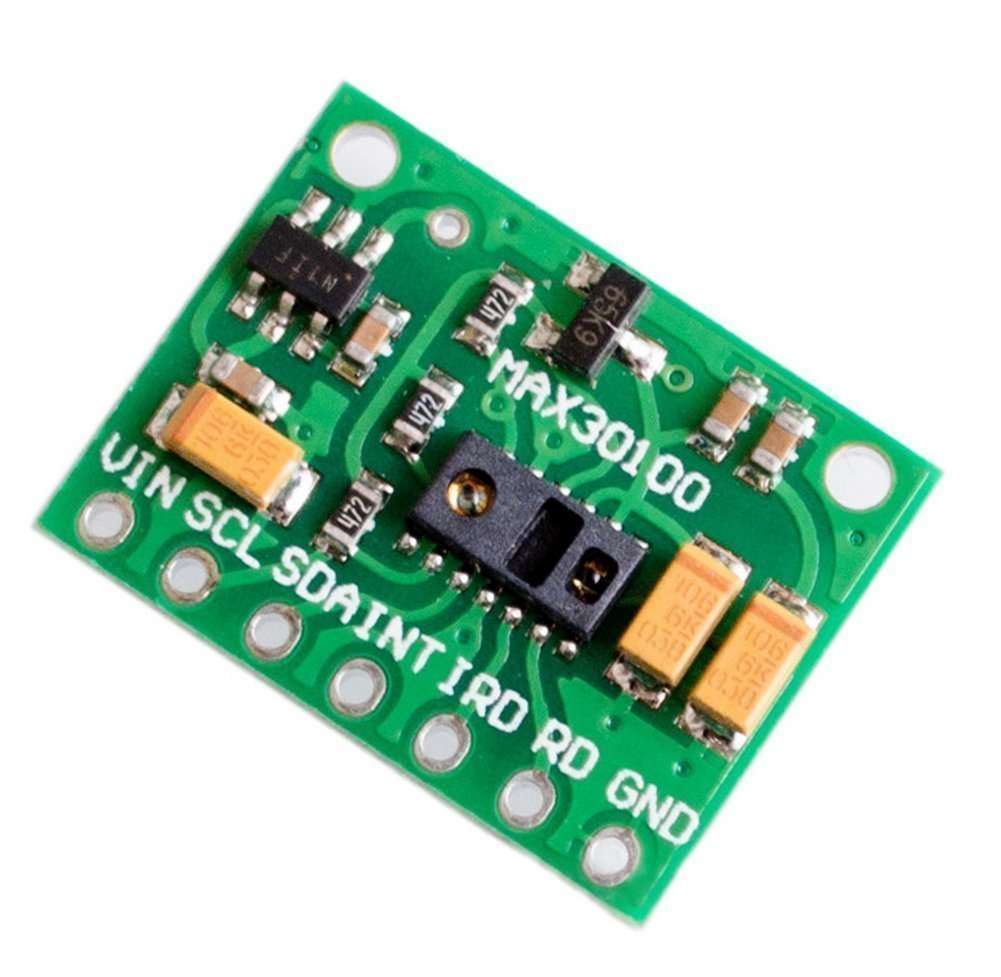
This premium listing features the highly stable green PCB breakout variant of the **MAX30100 Sensor**, which includes an onboard low-dropout linear regulator and data line pull-up resistors to eliminate power ripples and simplify hardware hookups. The core optical sensing packet integrates two specialized LEDs (one optimized for Red visible light and one optimized for Infrared light) alongside an ultra-low-noise photodetector and specialized ambient light cancellation circuitry. Build a full-scale wearable telemetry network by combining this biometric sensor link with our collection of Miniature OLED Display Modules and compact ESP32 NodeMCU Boards at VirtualPathshala.
Why Choose the Integrated MAX30100 Sensor for Wearable Prototyping?
Traditional discrete biometric circuits require complex analog amplification stages, multi-stage filtering arrays, and separate light shielding to prevent room light noise from ruining sensor readings. The MAX30100 Pulse Oximeter Sensor removes this implementation complexity entirely by housing all analog conditioning systems right inside a single silicon chip packet. Featuring an integrated 16-bit Sigma-Delta ADC converter and an automated ambient light cancellation engine, it handles noisy environmental signals entirely at the hardware level, passing clean data back over a standard two-wire $I^2C$ serial communication bus.
Key Features of the MAX30100 Pulse Oximeter Sensor Module
1. All-In-One Optical Subsystem Integration
The sensor packs its optical transmitter and receiver elements into a compact, specialized package. By aligning the red LED, infrared LED, and photodetector side-by-side behind an optically clear shield, it ensures consistent photon scattering paths through skin tissue, maximizing data accuracy when resting against a fingertip or earlobe.
2. Low-Noise 16-Bit Signal Processing Pipeline
The internal chip subsystem passes raw analog current waveforms through an integrated low-noise amplifier before driving a high-resolution 16-bit analog-to-digital converter (ADC). This deep bit depth captures subtle volumetric pulse wave variations, giving your software loops the high signal resolution needed to extract clear heart-rate metrics.
3. High-Efficiency Programmable LED Drive Controllers
To conserve power inside small battery-backed smart bands, the MAX30100 Pulse Oximeter Sensor features programmable LED pulse widths and current drive controls. The host microcontroller can adjust LED pulse durations and current limits through software registers, adapting sensor power draw to match different skin tones or battery profiles.
4. Comprehensive 3.3V to 5V I2C Interface Universality
Equipped with an onboard low-dropout (LDO) linear regulator, this module interfaces safely with the logic lines of all major prototyping and hardware development platforms without requiring external level converter chips:
- ✅ Arduino Uno / Nano / Mega links – Standard 5V power input line using native Wire library $I^2C$ pins
- ✅ ESP32 & ESP8266 NodeMCU boards – Direct 3.3V power rails for cloud-connected WiFi fitness tracking rings
- ✅ Raspberry Pi Single-Board Computers – Clean interface with standard 3.3V GPIO pins for Python data logging
5. Fast Ultra-Low Power Shutdown Mode
When vital signs monitoring is idle, the module can be placed into a deep software standby sleep mode via its control registers. In this sleep state, the internal LEDs turn off completely and the processing circuitry drops its active current draw down to an ultra-low 0.7µA typical, allowing for maximum battery preservation inside portable wearable enclosures.
MAX30100 Pulse Oximeter Sensor – Full Technical Specifications
| Sensor System Performance Metric |
Technical Specification Parameters |
| Electrical Characteristics |
|
| System Working Voltage Range |
3.3V to 5.0V DC Regulated Supply Input (VIN Pin) |
| Active Sampling Operating Current |
~1.5 mA to 3.5 mA Variable Working Current |
| Deep Software Shutdown Sleep Current |
0.7 µA Ultra-Low Passive Standby Current |
| Communication Interface Protocol |
Standard Two-Wire $I^2C$ Bus Line (SCL, SDA) |
| Fixed Hardware $I^2C$ Device Address |
0x57 (Hexadecimal Address Pointer) |
| Sensing Core Performance |
|
| Integrated Light Emitters Spectrum |
660 nm Visible Red LED | 880 nm Infrared (IR) LED |
| Internal Processing Converter Bit Depth |
Dual-Channel 16-bit Sigma-Delta ADC Engine |
| Programmable Pulse Width Windows |
200 µs, 400 µs, 800 µs, 1600 µs Configuration Limits |
| Programmable LED Current Ranges |
0 mA to 50 mA Max Injection Current Scaling |
| Maximum Sample Rate Capacity |
Up to 1000 Samples Per Second Programmable Rate |
| Physical Setup Measurements |
|
| Connecting Pin Header Layout |
7-Pins Out (VIN, SCL, SDA, INT, IRD, RD, GND) |
| Standard Pin Interface Space Pitch |
2.54 mm Breadboard-Friendly Holes |
| Overall PCB Module Board Size |
19.0 × 14.5 × 3.0 mm Substrate Footprint |
| Net Sensor Unit Weight |
2.2 Grams Ultra-Light Weight Assembly |
What Is Safely Included inside the Package
- ✅ 1× MAX30100 Pulse Oximeter & Heart-Rate Sensor Breakout Module
- ✅ 1× 7-Pin Male Header Strip Section (Unsoldered)
Frequently Asked Questions – MAX30100 Pulse Oximeter Sensor
Why does the MAX30100 sensor throw read timeouts or fail to initialize on some 5V Arduino boards?
The raw MAX30100 IC requires clean 1.8V and 3.3V power rails to operate correctly. While this green breakout board contains a regulator to drop VIN down to safe limits, some variations route the $I^2C$ SCL/SDA lines through 4.7K ohm pull-up resistors tied directly to the 1.8V rail. Standard 5V Arduino boards like the Uno require a minimum of 3.0V to register an $I^2C$ logic HIGH signal. If you hit initialization errors, verify you are using an updated software library or use a true 3.3V board like an ESP32 or Arduino Pro Mini.
What is the function of the “INT” pin on this breakout module?
The **INT** pin represents the hardware active-low Interrupt output line. Instead of forcing your host microcontroller code to loop constantly and poll the sensor registers for new data—which wastes CPU power—you can configure the MAX30100 to pull this INT pin LOW only when a new heart-rate sample is ready or when its internal FIFO buffer memory fills up, allowing your code to handle data via hardware interrupts efficiently.
How tightly should I press my finger against the optical sensor lens cover?
You should apply only very light, steady contact pressure. Pressing your finger down too hard against the clear shield squeezes the tiny blood capillaries in your fingertip tissue, cutting off the local arterial blood flow entirely. This stops the heart-rate signal from pulsing through the tissue, causing the sensor readings to drop out or show highly erratic values.
Order Your MAX30100 Pulse Oximeter Sensor Online Today
Build custom wearable health bracelets, create smart biometric security keys, or log real-time heart rate waves for your biological data projects with ease. Supplied across all Indian states with quick, dependable domestic shipping choices from VirtualPathshala. For official hardware register maps, sample Arduino sketches, and calibration software libraries, check our matching digital catalog items or reach out to our tech support team.







Reviews
Clear filtersThere are no reviews yet.