0.96-Inch Blue I2C OLED Display Module – High-Contrast 128×64 Resolution Miniature Graphic Screen
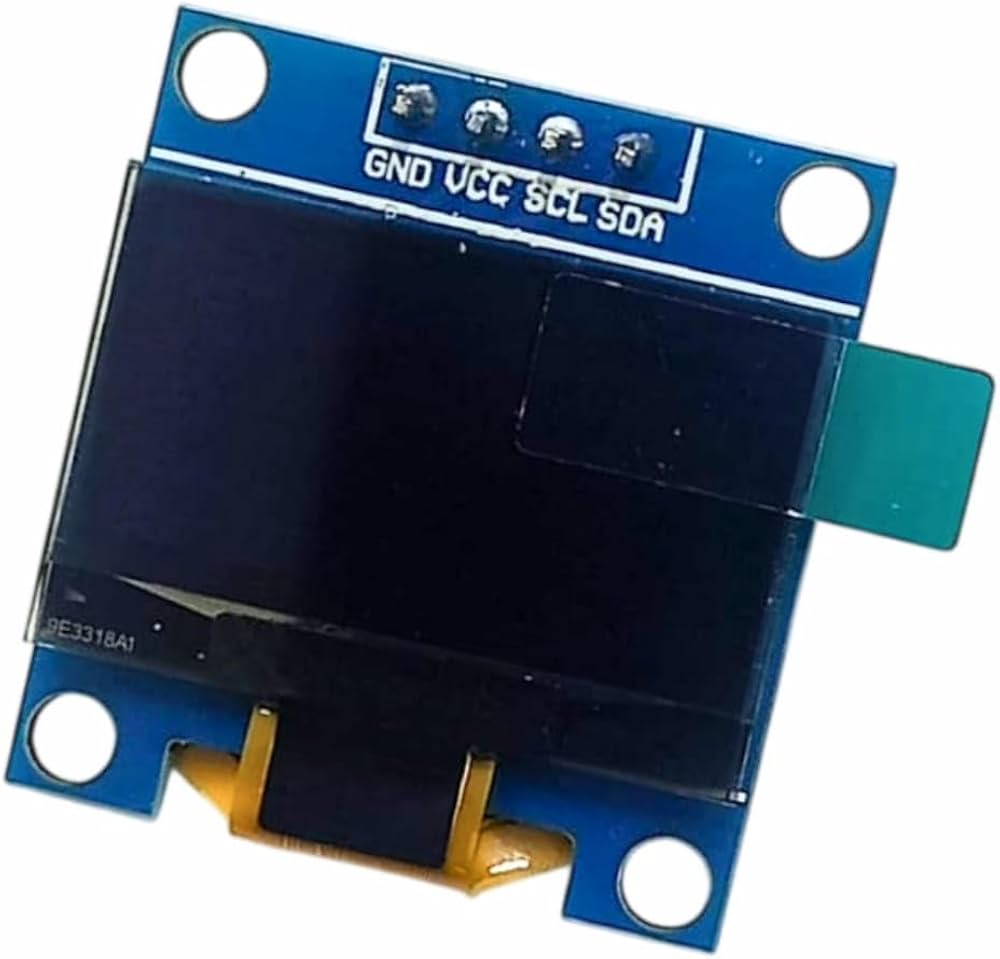
The 0.96 blue I2C OLED display module is an incredibly popular, ultra-sharp, and energy-efficient digital screen layout deployed extensively across India for wearable smart bands, DIY weather stations, desktop monitoring dashboards, and real-time sensor logging units. Driven by the industry-standard SSD1306 controller chip, this 0.96 blue I2C OLED display packs 128 columns by 64 rows of individually self-illuminating pixels. This solid-state design delivers vibrant blue text and crisp graphical readouts with near-infinite contrast ratios and an ultra-wide viewing angle exceeding 160 degrees.
This premium listing features the highly sought-after 4-pin configuration on a durable blue PCB substrate, with a protective plastic screen guard pre-installed on the glass face. Unlike old-generation liquid crystal panels, this organic light-emitting diode framework requires no separate, power-hungry backlight layer—making it exceptionally thin and remarkably low-power. Elevate your embedded interfaces by linking this miniature display panel with our massive inventory of IoT Environmental Sensors and premium Microcontroller Development Boards at VirtualPathshala.
Why Choose an OLED Screen Over Traditional 16×2 Character LCDs?
Standard character-limited displays are bulky, power-heavy, and restricted strictly to rendering blocky, unappealing text characters. The 0.96 blue I2C OLED display breaks free from those creative boundaries completely. Its full graphical pixel array allows developers to effortlessly render complex variable charts, animate loading icons, design custom menu layouts, and even display low-resolution image bitmaps. Because it isolates power strictly to pixels that are turned on, displaying deep black backgrounds keeps power draw to a minimal fraction of conventional display modules.
Key Features of the 0.96-Inch Blue I2C OLED Display Module
1. Crisp 128×64 Self-Illuminating Graphic Array
Because every single pixel inside the 0.96 blue I2C OLED display generates its own independent blue illumination when driven, it creates absolute true blacks by simply powering down unneeded zones. This crisp emission layer completely eliminates the irritating light-bleed washing common on backlit matrix screens, keeping your dashboard legible under poor indoor or ambient lighting conditions.
2. Streamlined Two-Wire I2C Interface Protocol
Say goodbye to complex parallel display wiring clusters that eat up to 10 or 12 digital pins on your control board. This breakout runs natively on a two-wire $I^2C$ serial communication bus interface, requiring only two data signals—SCL (Serial Clock) and SDA (Serial Data)—along with your power lines to display intricate tracking strings smoothly.
3. High-Performance Integrated SSD1306 Driver IC
The core panel comes integrated with the dependable SSD1306 control chip architecture. This embedded silicon houses internal display RAM, manages complex vertical pixel scrolling routines natively, and handles variable brightness command parsing entirely at the hardware level, dramatically saving your microcontroller’s processing cycle overhead.
4. Universal 3.3V to 5V Dual Logic Voltage Layout
Equipped with an onboard low-dropout linear regulator and matching logic-level resistors, this display panel syncs flawlessly with the data channels of all dominant hardware development ecosystems without requiring active external level shifter breakout chips:
- ✅ Arduino Uno / Nano / Mega links – Direct 5V power connection via native hardware I2C ports
- ✅ ESP8266 & ESP32 NodeMCU boards – Direct 3.3V operation for cloud-connected WiFi logging readouts
- ✅ Raspberry Pi Pico & Single-Board Units – Fast data routing via standard Python and C++ I2C driver blocks
5. Ultra-Lightweight & Drop-In Physical Profile
With a wafer-thin structural panel thickness of only several millimeters and a weight rating under 4 grams, it is highly optimized for integration inside tight spaces. Pre-drilled physical screw mounting holes placed at each corner of the PCB layout allow for rock-solid mechanical positioning inside sleek custom 3D-printed controller cases.
0.96 Blue I2C OLED Display – Full Technical Specifications
| Display System Performance Metric |
Technical Specification Parameters |
| Electrical Characteristics |
|
| System Working Voltage Range |
3.3V to 5.5V DC Regulated Input Line (VCC Pin) |
| Average Current Consumption (Normal Use) |
~15 mA to 20 mA (Varies based on total illuminated pixels) |
| Standby Sleep Mode Current Draw |
~100 µA Ultra-Low Idle Power State |
| Communication Interface Bus |
Standard Two-Wire Inter-Integrated Circuit ($I^2C$ Bus) |
| Default Hardware $I^2C$ Address Selection |
0x3C (Hexadecimal pointer address – default for most boards) |
| Display Core Performance |
|
| Display Screening Panel Technology |
OLED (Organic Light-Emitting Diode Frame) |
| Native Pixel Resolution Matrix |
128 Columns × 64 Rows (8192 Pixels Total) |
| Core Graphic Controller Chipset |
Integrated SSD1306 Controller IC |
| Pixel Color Emission Output |
Monochromatic Vivid Blue Output Pixels |
| Effective Viewing Angle Field |
> 160 Degrees Full Spherical Perspective |
| Operational Temperature Threshold |
-30°C to +70°C Temperature Testing Boundaries |
| Physical Structure Dimensions |
|
| Connecting Pin Header Layout |
4-Pins Header Block (GND, VCC, SCL, SDA) |
| Standard Pin Interface Space Pitch |
2.54 mm Breadboard-Friendly Socket Holes |
| Overall Module Substrate Dimensions |
27.3 × 27.8 × 4.1 mm Ultra-Thin Frame |
| Net Screen Unit Assembled Weight |
3.5 Grams Ultra-Light Weight |
What Is Safely Included inside the Package
- ✅ 1× 0.96-inch Blue I2C 128×64 OLED Display Module with Pre-Soldered 4-Pin Header Block
Frequently Asked Questions – 0.96 Blue I2C OLED Display
How do I wire this 0.96 blue I2C OLED display up to an Arduino Uno?
Wiring is quick and simple. Match the **VCC** pin to the Arduino’s 5V out and connect **GND** to system ground. For communication signals, hook the module’s **SCL** pin to the Arduino Uno’s dedicated hardware A5 analog pin (or the dedicated SCL pin near the USB jack), and attach the **SDA** pin to the A4 analog pin (or the dedicated SDA jack), then initialize your chosen library using the default `0x3C` I2C bus address.
What software libraries work best to render graphic elements on this screen?
The two most powerful and widely used open-source libraries are the **Adafruit_SSD1306** library (combined with the Adafruit_GFX core graphics engine) and the highly memory-efficient **U8g2** library. If you are using a basic microcontroller with limited flash memory like an Arduino Nano, using the U8g2 library’s text-only modes will save significant memory space compared to loading full graphic buffers.
Can I display characters or variables in different colors on this specific panel?
No. This model is a monochromatic hardware panel, meaning its internal organic pixels are manufactured to emit *only* blue light. If you try to change color parameters inside your software configuration loops, the pixels will simply light up at different grayscale brightness levels. If your project layout demands multi-color feedback, check out our dual-zone Yellow-Blue OLED or our full RGB color SPI display modules.
Order Your 0.96-inch Blue I2C OLED Display Online Today
Add professional, razor-sharp visual menus to your handheld gadgets, create real-time diagnostic printouts for your home automation arrays, or build modern data screens into your custom robotics platforms. Supplied across all Indian states with quick, dependable domestic shipping choices from VirtualPathshala. For official hardware data books, step-by-step wiring layouts, and open-source initialization scripts, review our matching catalog items or contact our tech support team.






Reviews
Clear filtersThere are no reviews yet.