Sound Detection Sensor Module – High-Sensitivity Acoustic Microphone and Noise Trigger Board
The Sound Detection Sensor Module is a highly responsive, cost-effective, and essential acoustic tracking board deployed extensively across India for voice-activated smart home appliances, security noise alarms, and interactive robotics projects. Utilizing a high-sensitivity electret condenser microphone capsule, the Sound Detection Sensor Module tracks real-time sound wave fluctuations in the surrounding atmosphere. When ambient sound pressures (such as a sharp finger snap, hand clap, or loud shout) hit the microphone membrane, the circuit processes the vibration data to trigger automated responses instantly.
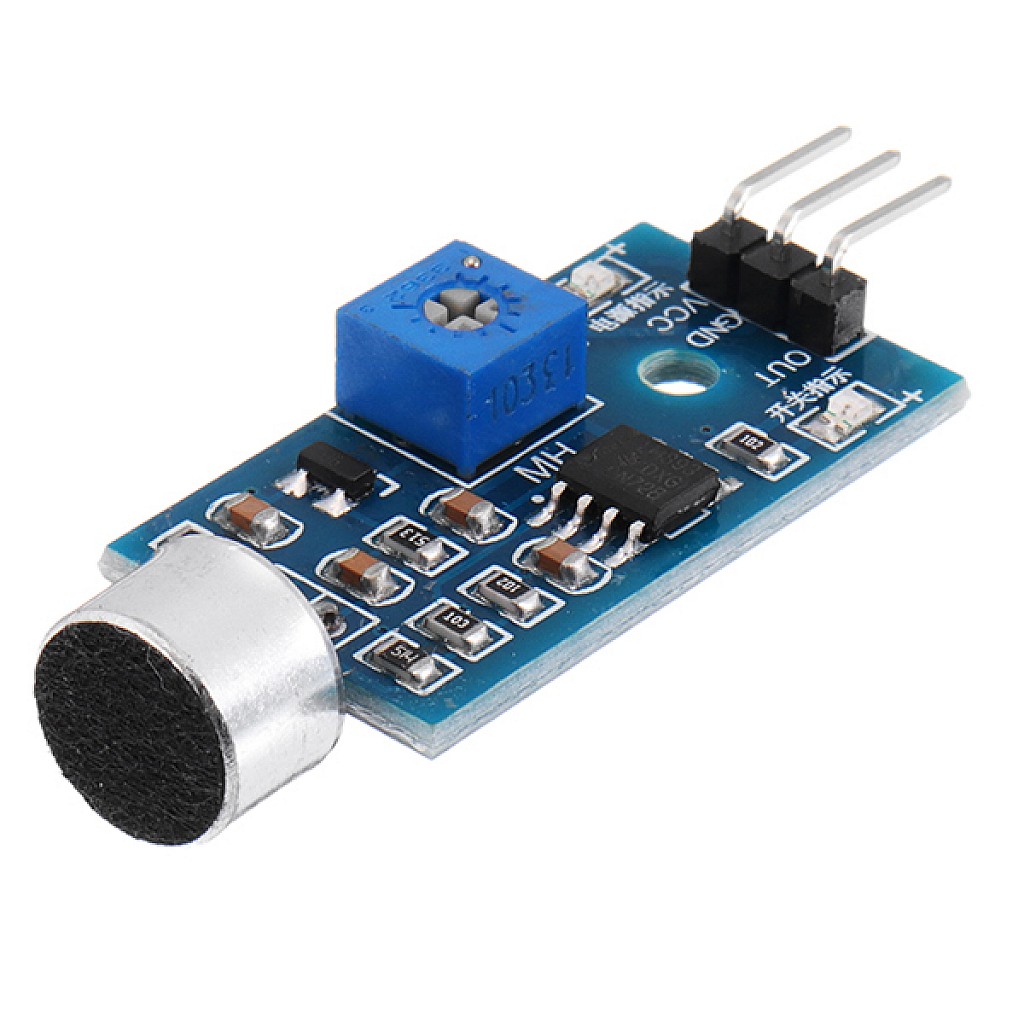
This premium listing is for the streamlined 3-pin **Acoustic Microphone Breakout Board**. It features an integrated LM393 voltage comparator chip, an onboard multi-turn potentiometer calibration dial, dual diagnostic LEDs, and a clean, hardware-debounced digital switching signal output. Build an intelligent sound-activated tracking network by combining this acoustic sensor link with our collection of Active Relay Switching Modules and high-visibility LED Matrix Displays at VirtualPathshala.
Why Choose This 3-Pin Sound Sensor Module for Clap-Activated Controls?
Reading raw audio waveforms directly into a basic microcontroller can lead to false triggers and code lag because processing analog audio requires high-speed sampling loops. The Sound Detection Sensor Module solves this design problem completely by using an onboard LM393 comparator circuit to clean up the signal. It evaluates the sound thresholds directly at the hardware level, passing a crisp digital logic signal back to your microcontroller. The streamlined 3-pin layout makes it highly breadboard-friendly, letting you build voice-activated clapper switches with minimal wiring overhead.
Key Features of the Sound Detection Sensor Module
1. High-Sensitivity Electret Condenser Microphone Capsule
The front edge of the Sound Detection Sensor Module houses a cylindrical electret microphone containing an ultra-lightweight, internal electrostatic membrane. This capacitive acoustic core picks up high-frequency and low-frequency decibel shifts across a broad directional zone, making it exceptionally reliable at capturing short, transient sound bursts like claps or knocks.
2. Hardware-Debounced Digital Output via LM393 Comparator
The onboard LM393 comparator chip constantly evaluates the voltage shifts from the microphone capsule against your preconfigured target limit. The module processes this acoustic data entirely at the hardware level, delivering a clean digital switching signal (OUT) that transitions instantly between high and low logic states without any signal noise or contact chatter.
3. Onboard Sensitivity Calibration Potentiometer
Adjusting the acoustic trigger range requires no software recalibrations or complex code adjustments. The board features a blue multi-turn trimmer potentiometer. Turning this screw dial adjusts the comparison threshold voltage on the LM393 chip, allowing you to fine-tune the sensor’s range—from triggering only at loud, nearby noises to capturing quiet environmental whispers.
4. Comprehensive 3.3V to 5V Microcontroller Compatibility
Designed to operate seamlessly within standard digital I/O constraints, this module interfaces flawlessly with a wide variety of development platforms without requiring active level conversion components:
- ✅ Arduino Uno / Nano / Mega links – Direct 5V power connection with standard digital pin reads
- ✅ ESP8266 & ESP32 NodeMCU boards – Safe 3.3V operation for cloud-connected voice alarm networks
- ✅ Raspberry Pi Single-Board Computers – Clean interface with standard 3.3V GPIO input lines
5. Built-In Dual Visual Status Diagnostic LEDs
Setting up and testing the sensor in the field is quick and straightforward thanks to the dual surface-mount onboard LEDs. The first LED lights up continuously to show that the board is getting clean input power, while the second digital output LED flashes the exact millisecond an active noise spikes past your sensitivity limit, simplifying calibration without requiring a serial monitor.
Sound Detection Sensor Module – Full Technical Specifications
| Module Component Metric |
Technical Specification Parameters |
| Electrical Characteristics |
|
| Operating Input Voltage Range |
3.3V to 5.5V DC Regulated Input (VCC Pin) |
| Active Operating Current Draw |
~10 mA to 15 mA Typical Working Current |
| Integrated Comparator Chipset |
Onboard High-Precision LM393 IC Core |
| Output Signal Format |
Digital TTL Switch Status Level (OUT Pin) |
| Digital Output Current Drive Capacity |
> 15 mA Clean Current Sink/Source |
| Sensing Core Performance |
|
| Acoustic Sensing Element Type |
High-Gain Electret Condenser Microphone Capsule |
| Effective Frequency Tracking Range |
50 Hz to 20,000 Hz Audio Waveform Bounds |
| Quiet / Ambient State Output Logic Level |
Digital Output stays HIGH by default |
| Sound Triggered State Output Logic Level |
Digital Output drops LOW immediately during peak sound |
| Physical Dimensions |
|
| Terminal Pin Connection Headers |
3-Pin Interface (OUT, GND, VCC) |
| Standard Pin Header Space Pitch |
2.54 mm Breadboard-Friendly Holes |
| Overall PCB Module Dimensions |
32.0 × 17.0 × 15.0 mm Assembly Size |
| Net Sensor Unit Weight |
4.0 Grams Ultra-Light Footprint |
What Is Safely Included inside the Package
- ✅ 1× High-Sensitivity Sound Detection Sensor Module (3-Pin Blue PCB Version)
Frequently Asked Questions – Sound Detection Sensor Module
How does this 3-pin Sound Sensor Module differ from the 4-pin variant?
The 4-pin variant breaks out an extra Analog Output (AO) pin, which provides a shifting voltage wave to log raw audio shapes or calculate decibel curves. This 3-pin **Sound Detection Sensor Module** focuses purely on high-speed digital sound triggering. It evaluates the noise threshold right on its own board using the LM393 chip, making it easier to integrate by feeding a simple high/low trigger pulse directly to your microcontroller.
What causes the digital output pin to drop LOW instead of jumping HIGH when a clap is detected?
This behavior is standard for many active-low LM393-based sensors. When the electret microphone catches an acoustic wave spike, its internal capacitance shifts rapidly, causing the comparator circuit to pull the digital output (OUT) line down to 0V (LOW). In your Arduino sketch, you can monitor this transition by checking for a standard `if (digitalRead(sensorPin) == LOW)` condition to trigger your clapper relay.
Can this sensor module be used to identify specific voice commands or spoken words?
No. This module is an amplitude-based sound threshold detector, meaning it only measures whether a noise is louder or quieter than your potentiometer setting. It does not possess the complex signal processing or memory required to perform voice recognition or frequency analysis. It is best optimized for high-speed binary sound tracking like hand claps, door knocks, or impact pops.
Order Your Sound Detection Sensor Module Online Today
Automate your household lights with smart clap commands, protect your property with noise-activated security alarms, or add fun sound-reactive triggers to your interactive robotics exhibits. Supplied across all domestic Indian locations with fast, reliable shipping networks from VirtualPathshala. For official circuit schematics, clapper switch sample code repositories, and complete connection tutorials, please review the Official Texas Instruments LM393 Core Application Hub.







Reviews
Clear filtersThere are no reviews yet.