ESP32-C3 SuperMini Development Board – High-Performance RISC-V Architecture in a Thumb-Sized IoT Footprint
The ESP32-C3 SuperMini development board is an incredibly small, power-optimized, and high-performance microcontroller unit deployed extensively across India for wearable technology, smart localized asset trackers, hidden IoT remote sensor nodes, and space-constrained robotics configurations. Built around Espressif’s cutting-edge open-source open-source 32-bit RISC-V single-core architecture running up to 160MHz, the ESP32-C3 SuperMini brings modern 2.4GHz Wi-Fi and Bluetooth Low Energy (BLE 5.0) wireless capabilities directly to tight form-factor applications that are too small to house traditional ESP32 or NodeMCU dev boards.
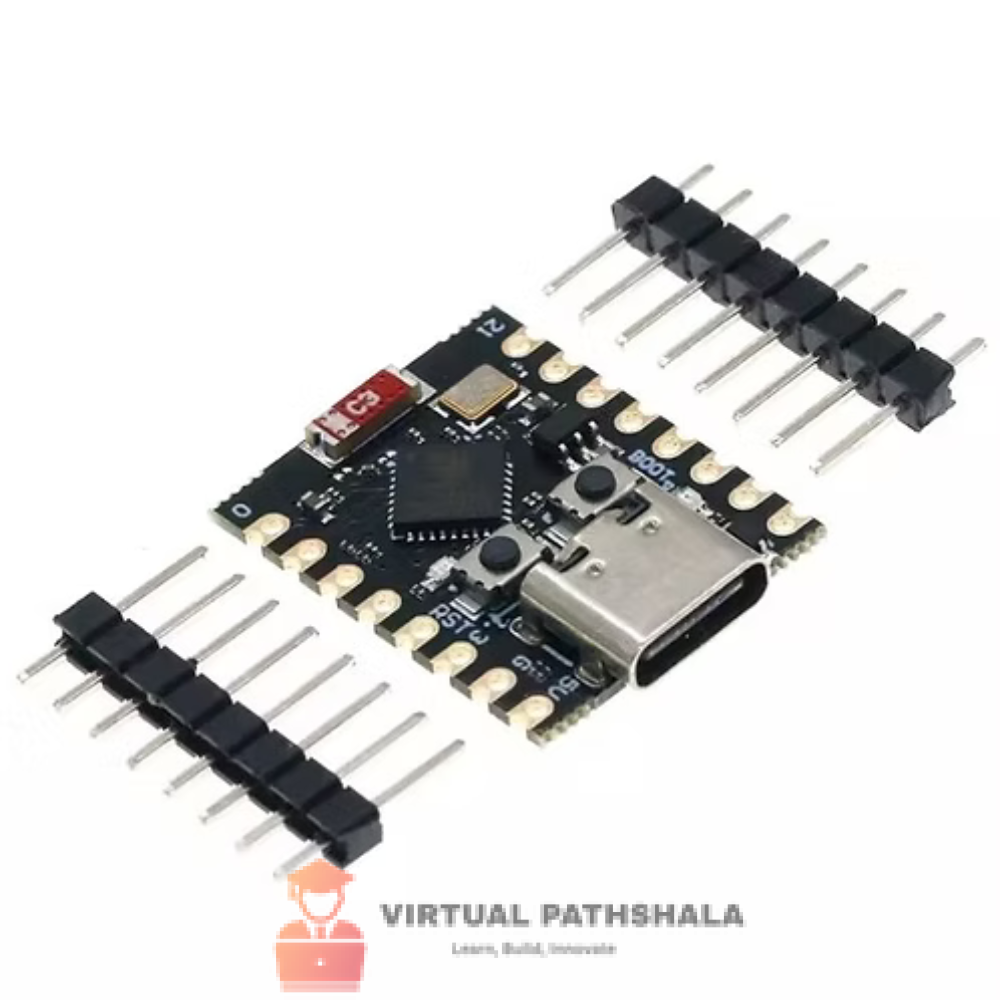
This premium listing highlights the ultra-miniature black PCB design available at VirtualPathshala. The board features castellated solder holes along its edges, allowing it to serve both as a standard breadboard-friendly prototyping module and as a surface-mountable daughterboard layout directly reflowed onto a custom motherboard PCB substrate. It comes equipped with a modern, rugged USB Type-C connector port for high-speed programming alongside discrete physical BOOT and RESET mechanical switches. Complete your micro-automation design by pairing this tiny powerhouse with our selection of Miniature I2C Sensor Breakouts and low-profile OLED Pixel Screens.
Why Choose the RISC-V Powered SuperMini Layout Over Classic ESP8266 Chips?
Older generation IoT chips like the ESP8266 or basic ESP-12E layouts are bulky, run on outdated processing instruction sets, and lack secure encryption engines or modern low-power Bluetooth protocols. The ESP32-C3 SuperMini systematically replaces those older variants by integrating a highly efficient, single-core RISC-V processor that delivers superior computing output per milliwatt. Furthermore, by embedding hardware cryptographic acceleration engines alongside native Bluetooth 5.0 LE wireless pathways, it allows for fast, secure smartphone configuration and long-distance sensor broadcasting while operating comfortably on tiny lithium coin cell arrays.
Key Features of the ESP32-C3 SuperMini Development Board
1. High-Performance 32-Bit RISC-V Core Processing Architecture
The core engine driving the ESP32-C3 SuperMini is a modern single-core Tensilica-alternative RISC-V microprocessor running at a rapid 160MHz clock speed. Backed by 400KB of internal SRAM and a generous 4 Megabytes of onboard SPI flash memory, it parses complex data streaming loops and security handshakes flawlessly.
2. Dual Wireless Modality (2.4GHz Wi-Fi & Bluetooth LE 5.0)
The chip contains a complete, integrated radio subsystem layout. It supports stable 802.11 b/g/n Wi-Fi networks for direct cloud communication protocols (like MQTT or HTTP) alongside Bluetooth 5.0 Low Energy mesh configurations, enabling long-range remote sensor telemetry networks with minimal power draw metrics.
3. Modern USB Type-C Port with Native USB-Serial CDC Hardware
Say goodbye to external USB-to-UART bridge chips (like the CH340 or CP2102) that steal valuable PCB board space. The ESP32-C3 SuperMini utilizes the chip’s native internal USB peripheral routing directly to its Type-C jack, allowing for direct driverless programming and serial debugging out of any standard computer system.
4. Castellated Edge Pads for Surface-Mount Integration
The low-profile design breaks out 11 functional GPIO channels using versatile castellated edge holes. This professional layout means you can solder standard pins on for breadboard testing, or skip pins completely to flush-mount the module directly flat against your own custom product motherboards to minimize structural heights.
5. Advanced Onboard Power Management and Charging Protection
The board houses an advanced, low-dropout (LDO) linear voltage regulator capable of handling standard 5V DC power inputs through the Type-C port or raw `5V` solder pins. It scales input potentials down to a stable 3.3V system rail while managing internal current limits to protect the core processing layers against voltage ripple shifts.
ESP32-C3 SuperMini Board – Full Technical Specifications
| System Core Microcontroller Component |
Technical Specification Parameters |
| Core Processing Unit & Memory |
|
| Main Microprocessor Core Architecture |
32-bit RISC-V Single-Core Processor running up to 160 MHz max |
| Internal Volatile Memory (SRAM) |
400 KB High-Speed Internal SRAM Cache |
| External SPI Flash Storage Capacity |
4 Megabytes (4MB) Integrated Flash Module |
| Onboard Low-Power Clock Core |
Built-in RTC Timer for Deep Sleep Low-Power Management |
| Wireless Radio Subsystem |
|
| Wi-Fi Wireless Networking Protocol |
2.4 GHz Band (802.11 b/g/n) with 150 Mbps Max Data Throughput |
| Bluetooth Wireless Protocol Standard |
Bluetooth 5.0 Low Energy (BLE) with Long-Range Mesh Support |
| Integrated Radio Antenna Type |
Onboard High-Gain Ceramic Chip Antenna Element |
| Peripheral Interfaces & Pinouts |
|
| Digital General Purpose I/O Channels |
11× Multi-Function GPIO Pins broken out to edge pads |
| Analog-to-Digital Converter Channel (ADC) |
4× High-Resolution 12-bit SAR ADC Channels |
| Serial Hardware Bus Protocols |
1× I2C, 1× SPI, 2× UART, Multi-Channel PWM output pins |
| Physical Mechanical Switches |
Onboard BOOT Push-Button + RST (System Reset) Switch |
| Electrical Power Parameters |
|
| Main Power Interface Ports Input |
Standard USB Type-C Socket Data Interface Line |
| External Raw Input Supply Range |
5.0V DC Input via Type-C or VCC/5V Edge Solder Pad |
| Core System Working Logic Voltage |
3.3V DC (Regulated via onboard low-ripple LDO chip) |
| Overall Miniature Board Size Dimensions |
22.5 × 18.0 × 4.5 mm Thumbnail Form Factor Profile |
What Is Safely Included inside the Package
- ✅ 1× ESP32-C3 SuperMini Development Board (Black PCB Assembly)
- ✅ 2× 8-Pin High-Quality Male Header Strip Sections (Unsoldered)
Frequently Asked Questions – ESP32-C3 SuperMini
Why does the ESP32-C3 SuperMini fail to register as a COM port on my computer out of the box?
Because the **ESP32-C3 SuperMini** utilizes native internal USB-CDC serial routing rather than a separate hardware bridge chip, it requires the microcontroller to be running active internal firmware to communicate over the USB line. If your board has a blank flash memory or gets caught in a bootloader loop, hold down the onboard **BOOT button**, plug the Type-C cable into your computer, and press the **RESET button** once before releasing the BOOT button. This forces the RISC-V core into its hardwired ROM bootloader state, instantly exposing the COM port to your Arduino IDE software.
How do I wire and configure this module to consume minimal current during deep sleep?
The RISC-V architecture features excellent power optimization models. In software, you can configure the core to enter deep sleep mode using the native `esp_deep_sleep_start()` commands, which powers down the internal Wi-Fi/Bluetooth radios and halts main core execution, dropping active current draws down to just several microamps—making it highly efficient for remote environmental lithium-backed telemetry trackers.
Can I connect an external antenna to this module to boost its wireless range?
This specific layout variant is populated with a high-efficiency compact ceramic chip antenna designed to maximize signal transmission profiles inside miniature enclosures. It does not include an external U.FL / IPEX micro-coaxial connector port. For optimal wireless range performance, avoid placing the module inside enclosed solid metal boxes, and mount the ceramic antenna face pointing away from large metallic battery shells or structural frame elements.
Order Your ESP32-C3 SuperMini Board Online Today
Add powerful RISC-V single-core computing and dual wireless connectivity networks to your miniature wearables, hidden smart home trackers, or space-constrained robotics designs with ease. Dispatched across all domestic Indian locations with fast express delivery options and commercial invoices from VirtualPathshala. For official pinout map sheets, open-source C++ sample code templates, and schematic diagrams, please contact our support helpline.






Reviews
Clear filtersThere are no reviews yet.