DS3231 RTC Module – High-Precision Temperature-Compensated Clock Breakout for Advanced Data Logging
The DS3231 RTC Module is an ultra-accurate, cost-effective, and highly dependable I2C real-time clock breakout board deployed extensively across India for industrial data loggers, automated attendance systems, school bell timers, and solar tracking arrays. Built around Maxim Integrated’s premium DS3231 silicon engine, this DS3231 RTC Module systematically resolves the time-drift flaws found in low-end clock boards. It guarantees that your embedded systems maintain the exact second, minute, hour, day, and calendar date parameters even when isolated from a live internet connection or network time protocol (NTP) server links.
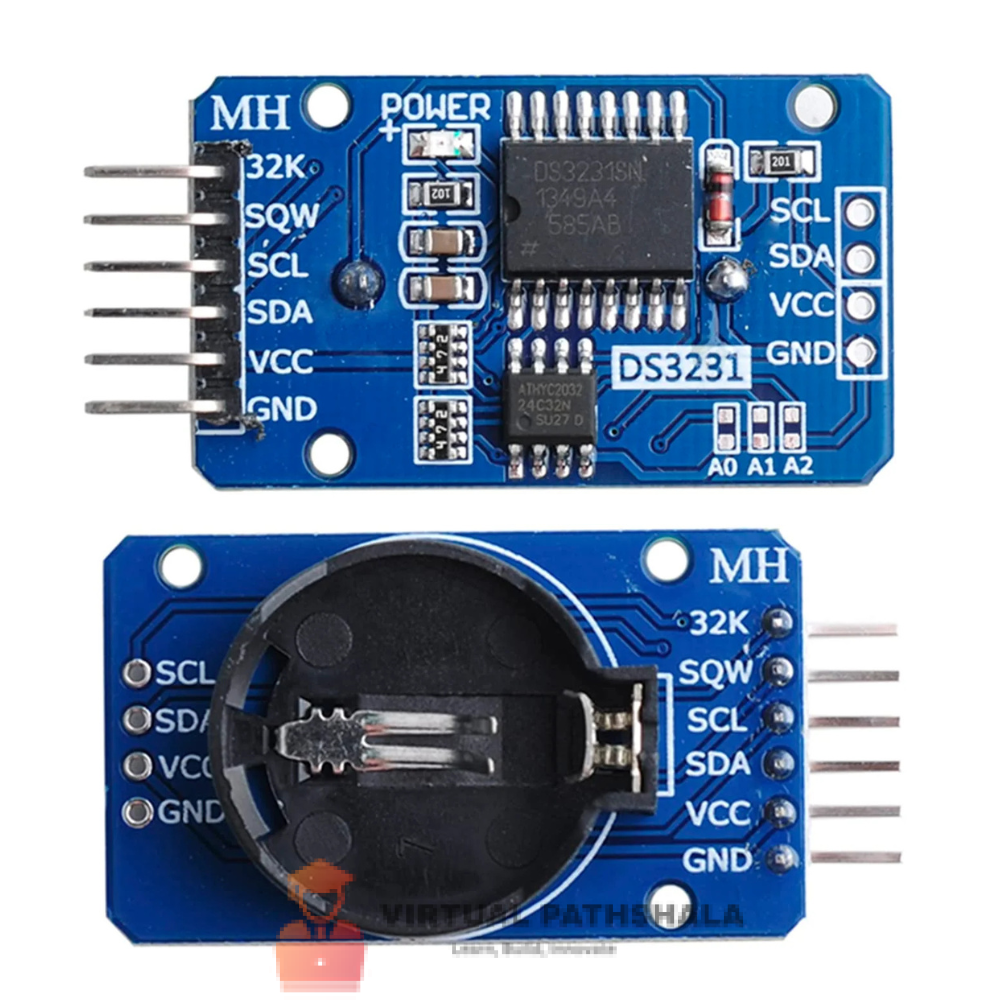
This premium variant available at VirtualPathshala integrates an onboarding 32Kbit (4KB) AT24C32 serial EEPROM memory chip. This bonus storage space allows makers to store user alarms, sensor schedules, or system event logs directly onto the module without exhausting your microcontroller’s internal EEPROM memory limits. The PCB features dual I2C wiring rails, meaning multiple sensors can share the same communication bus wires without clashing. Complete your industrial timing framework by pairing this precise clock node with our catalog of Arduino Uno R3 Mainboards, I2C 16×2 Character LCD Screens, and high-capacity MicroSD Card Data Logger Shields.
Why Is a Temperature-Compensated Crystal Oscillator (TCXO) Crucial for Accurate Timekeeping?
Standard clock modules (like the older DS1307 series) rely on external 32.768kHz tuning-fork crystals. These external crystals are highly sensitive to ambient environmental temperatures; hot summers or cold winter nights cause the crystal’s vibration rate to shift slightly, leading to a cumulative drift of several minutes every single month. This DS3231 RTC Module systematically eradicates this problem. The module houses an internal crystal resonator nestled right next to a highly accurate 10-bit digital temperature sensor. Every 64 seconds, the chip monitors internal temperature shifts and adjusts the clock’s ticks dynamically to preserve a stable ±2ppm accuracy rating (equivalent to less than 1–2 minutes of drift over an entire year).
Key Features of the DS3231 RTC Module
1. High-Precision Integrated TCXO Timing Engine
By nesting the quartz crystal inside the sealed DS3231 package alongside an automated thermal compensation matrix, the module remains completely immune to external moisture, dust, or temperature fluctuations. This design provides robust stability across an expansive industrial thermal range from -40°C to +85°C.
2. Dual Fully Programmable Time-of-Day Alarms
The hardware engine houses two independent, software-configurable alarms. These alarms can be programmed to trigger custom routines every second, minute, hour, or specific day of the week. This versatility makes the module highly effective for creating power-saving routines that wake up sleeping microcontrollers to take readings at specified intervals.
3. Onboard 32Kbit Non-Volatile AT24C32 Serial EEPROM Memory
The layout features an independent AT24C32 flash storage sector accessible over the I2C bus at a separate address (0x57). This section lets developers safely lock in non-volatile data arrays—such as customized alarm thresholds, sensor calibration profiles, or historical time-stamps—that remain preserved even during complete system power losses.
4. Automated Battery-Backup Power Switching Architecture
The module features a pre-soldered coin cell battery holder on its underside. An internal voltage comparator circuit constantly monitors the main VCC power line. If the main power line goes down, the chip switches cleanly over to the backup battery in micro-seconds, ensuring timekeeping remains uninterrupted without causing any data resets or system freezes.
5. Multi-Functional Square-Wave and Interrupt Pin Outputs
Beyond standard data reporting, the board exposes multi-functional hardware channels. The **SQW pin** can be configured via software to emit a highly stable square-wave signal reference at 1Hz, 4.096kHz, 8.192kHz, or 32.768kHz, making it useful for driving external hardware interrupts or clock calibration tools.
DS3231 RTC Module – Full Technical Specifications
| Clock Module System Performance Metric |
Technical Specification Parameters |
| Core Electrical Performance |
|
| Working Input Voltage Range (VCC) |
2.3V to 5.5V DC Stable Input |
| Active Data I2C Bus Current Draw |
< 200 µA Peak Active Streaming Current |
| Timekeeping Battery Supply Draw |
~1 µA Ultra-Low Idle Standby Leakage |
| Full Timing Accuracy Threshold Scale |
±2ppm (0°C to +40°C) | ±3.5ppm (-40°C to +85°C) |
| Cumulative Time Drift Scale |
Less than ~1 Minute Total Deviation Per Calendar Year |
| Memory & Interface Attributes |
|
| Core Clock Management Silicon IC |
Maxim Integrated DS3231 Precision Timing Engine |
| Auxiliary Onboard Memory Storage Chip |
AT24C32 32Kbit (4 Kilobytes) Serial I2C EEPROM |
| Default Hardware I2C Device Addressing |
DS3231 Core: 0x68 Fixed | AT24C32 EEPROM: 0x57 default |
| I2C Bus Communication Speeds |
Fast Mode I2C Data Transfers up to 400 kHz Max Rate |
| Onboard Temperature Sensor Precision |
10-bit Digital Core with ±3°C Absolute Accuracy Window |
| Physical Setup & Battery Specifications |
|
| Compatible Coin Cell Battery Profile |
CR2032 or LIR2032 3V Lithium Coin Cell Format |
| Input Interface Connecting Pins Mapping |
6-Pin Through-Hole Header (VCC, GND, SDA, SCL, SQW, 32K) |
| Overall Module PCB Profile Dimensions |
38.0 × 22.0 × 14.0 mm Compact Tracker Board |
| Net Assembled Module Unit Weight |
8.0 Grams Featherweight Timing Assembly Core |
What Is Safely Included inside the Package
- ✅ 1× DS3231 AT24C32 I2C Precision RTC Module (Pre-Assembled Board)
- ⚠️ Note: A CR2032 backing coin cell battery is not included by default and must be sourced separately.
Frequently Asked Questions – DS3231 RTC Module
What is the function of the 32K pin broken out on the edge header?
The **32K pin** outputs a direct, unadjusted 32.768kHz square-wave signal pulled directly from the internal TCXO oscillator core. This raw, highly stable output bypasses the internal dividers and registers, making it useful as a highly precise external hardware clock reference for synchronization across multiple separate microcontrollers or specialized logic analyzer tools.
Can I use a standard, non-rechargeable CR2032 lithium battery on this module?
Yes, but you should take one quick precaution. These standard, low-cost modules include a basic built-in trickle-charging circuit designed for rechargeable **LIR2032** batteries. If you insert a standard, non-rechargeable **CR2032** coin cell, the module will attempt to feed charging current back into it while main VCC power is connected, which can eventually cause a standard cell to swell or leak. To safely use a standard CR2032 battery for years, simply desolder or clip the tiny 1N4148 diode or the 200$\Omega$ charging resistor on the PCB to disable the charging circuit entirely.
How do I set the correct time on the module for the first time?
Setting the initial time is a quick, straightforward process using the standard `RTClib` library in the Arduino IDE. In your setup loop, calling the command `rtc.adjust(DateTime(F(__DATE__), F(__TIME__)))` will read your computer’s exact compile-time at the moment the sketch is uploaded and instantly flash it onto the DS3231’s registers. Once configured, the onboard battery will keep the clock running accurately even when your project is completely powered off.
Order Your DS3231 RTC Module Online Today
Equip your tracking projects with high-precision, drift-free timekeeping, implement reliable scheduling controls, and expand your non-volatile system event storage capabilities. Dispatched across all domestic Indian locations with quick, dependable express shipping options from VirtualPathshala. For official datasheet register maps, open-source C++ code libraries, and volume discounts, contact our live support desk.







Reviews
Clear filtersThere are no reviews yet.