




ESP32 IoT Starter Kit – OLED Display, Sensors, Relay, Breadboard & Components for STEM Education
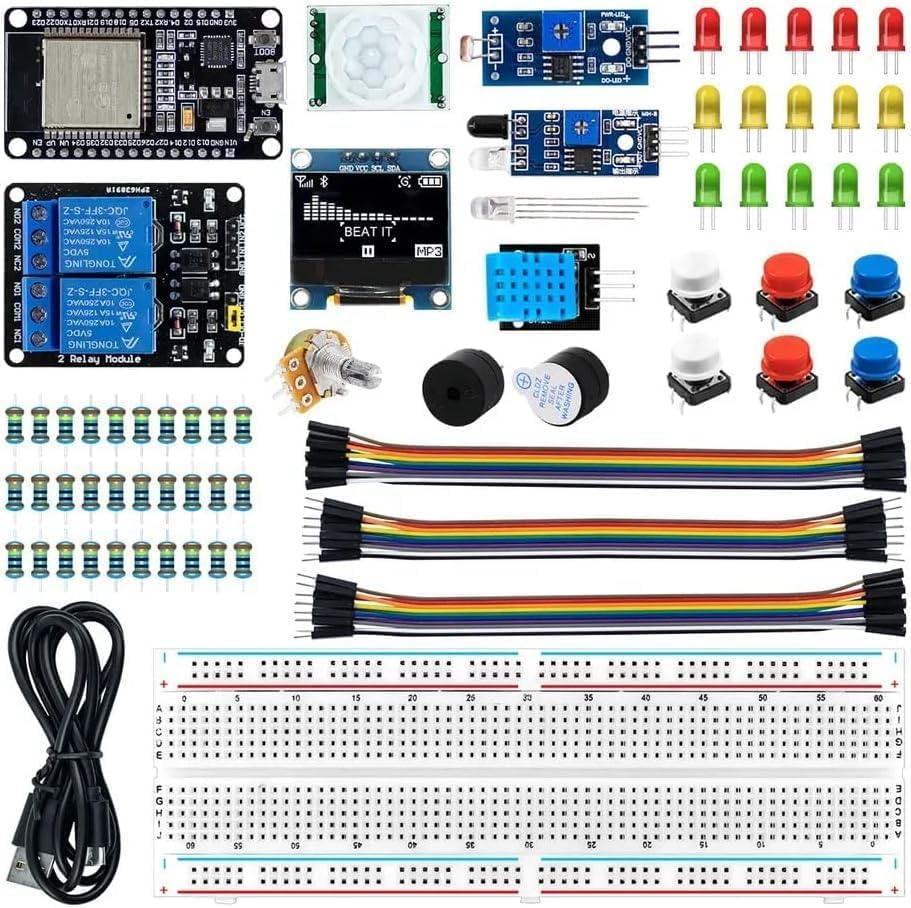
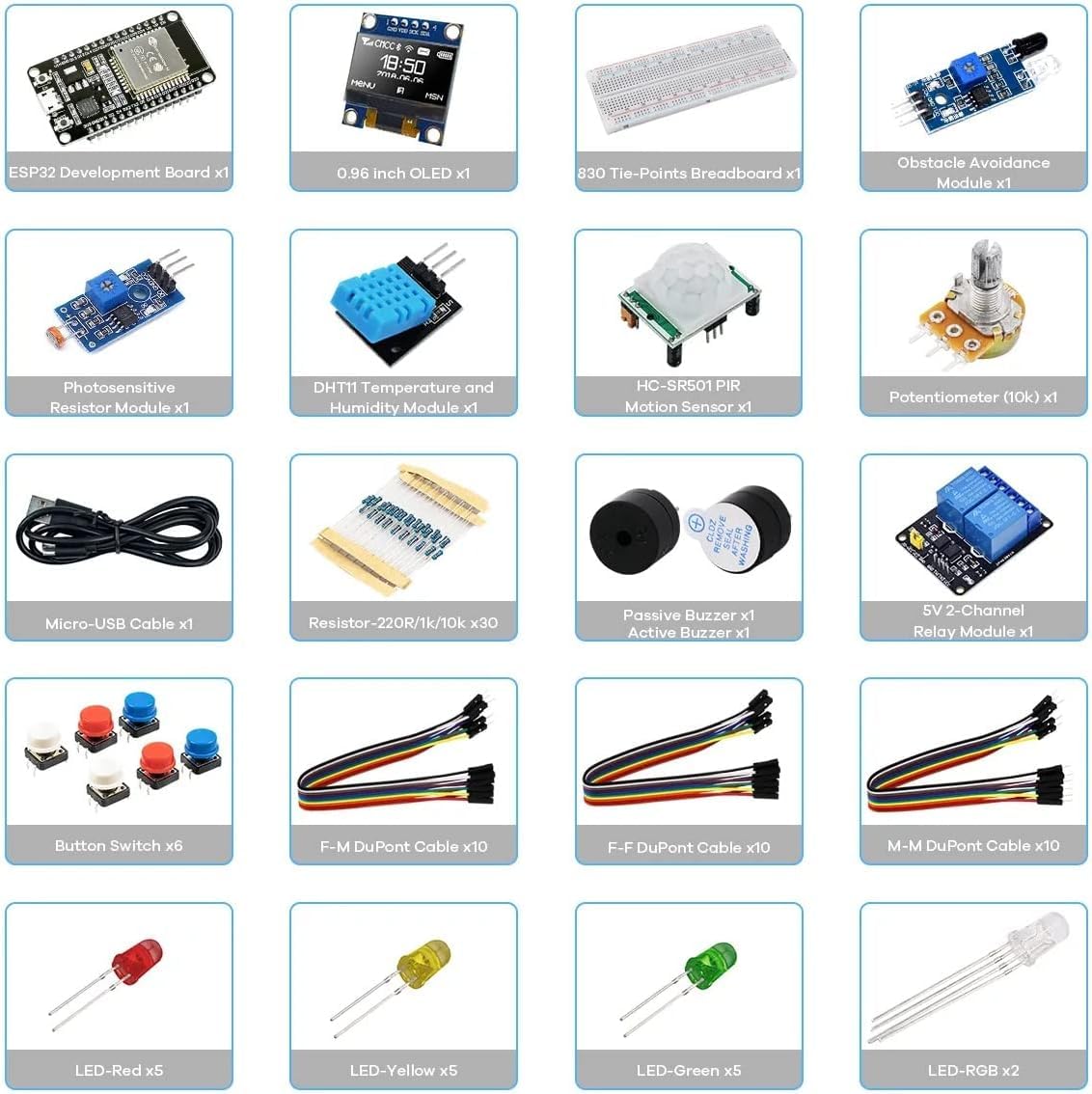
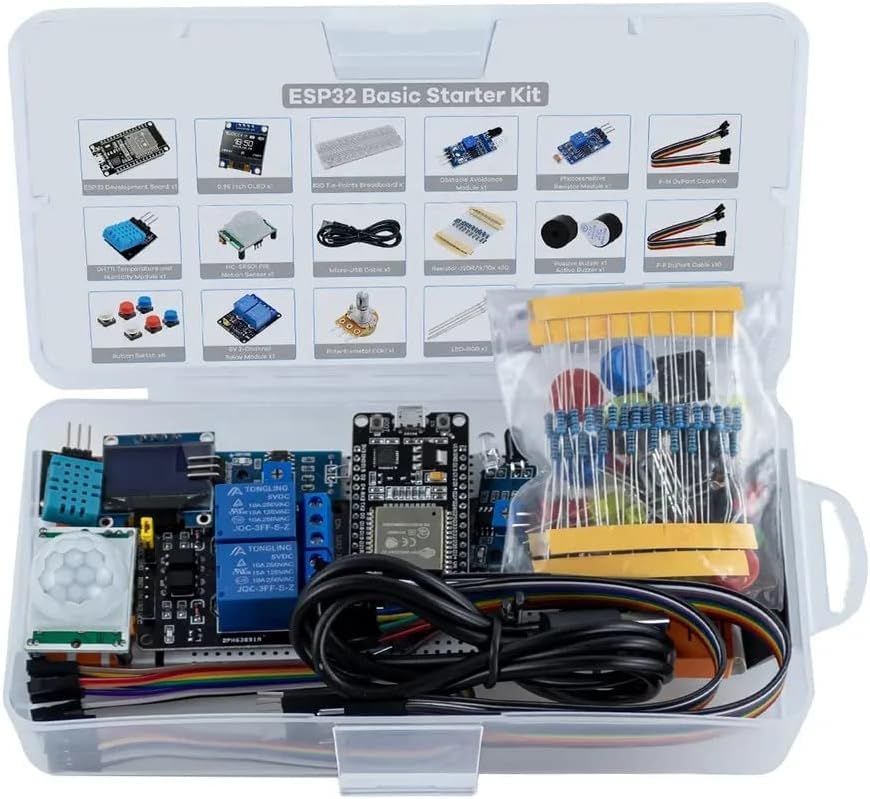
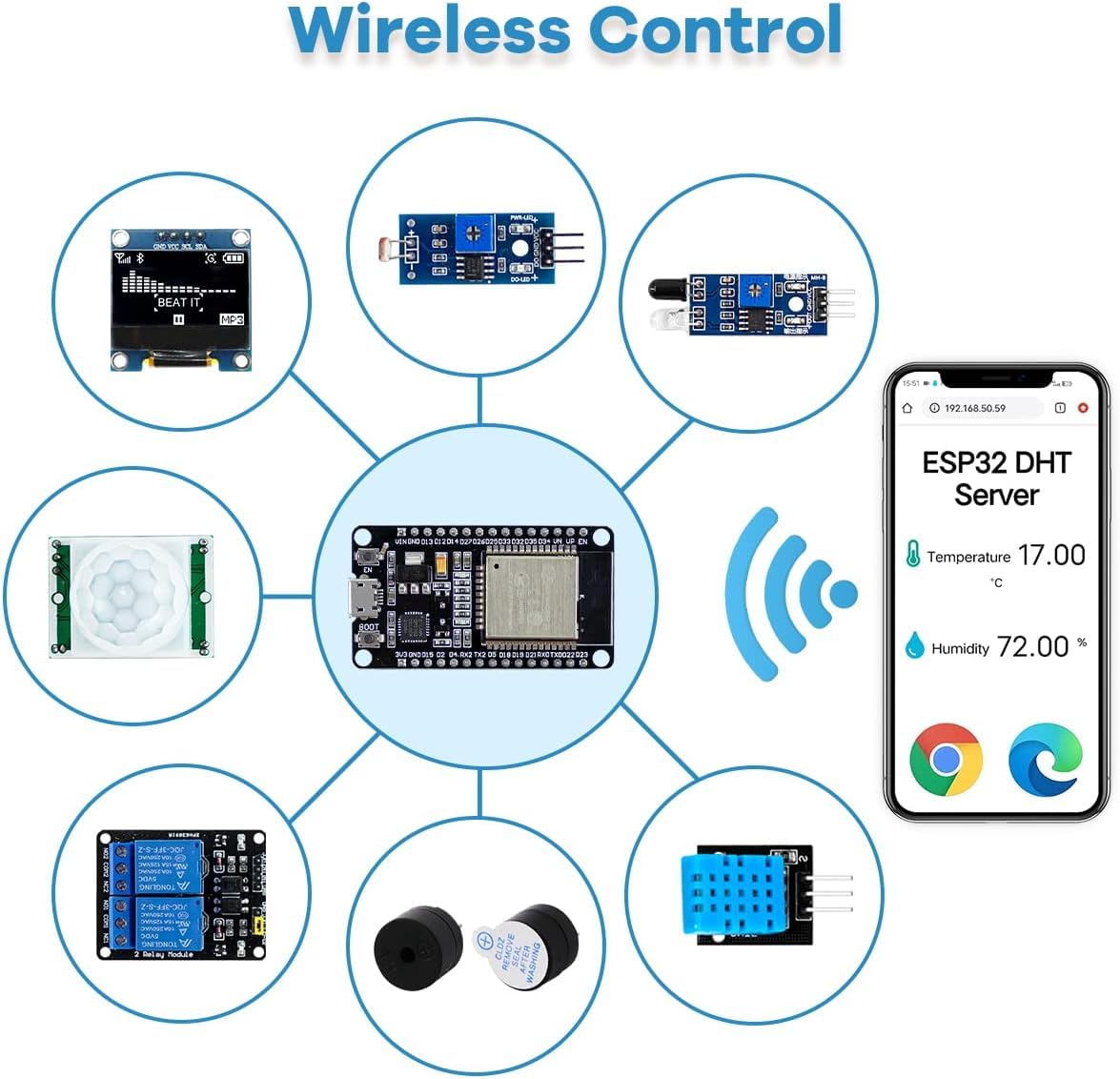
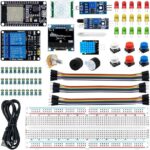
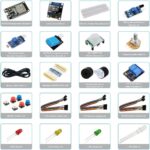
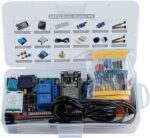
The ESP32 IoT Starter Kit is a complete 37-component Wi-Fi and Bluetooth electronics learning kit for students and makers. Includes ESP32 NodeMCU, 0.96-inch OLED display, 2-channel relay module, PIR motion sensor, DHT11 temperature and humidity sensor, LDR light sensor, IR receiver, RGB LED, 15 individual LEDs, 2 buzzers, rotary potentiometer, 6 push buttons, 24 resistors, 830-point breadboard, micro-USB cable, and 3 jumper wire bundles. Build real IoT projects from day one — no soldering required.
₹1,999.00 Original price was: ₹1,999.00.₹1,649.00Current price is: ₹1,649.00.
Description
ESP32 IoT Starter Kit – The Most Complete Wi-Fi and Bluetooth Electronics Learning Kit
for Students and Makers in India
The ESP32 IoT Starter Kit is the most comprehensive and beginner-friendly
Internet of Things learning kit available in India today. Built around the powerful
ESP32 NodeMCU development board — with dual-core processing, built-in Wi-Fi, and
Bluetooth — this kit gives students, hobbyists, and engineers everything they need to
build real IoT projects from day one. From a smart home automation relay controller
to a weather monitoring dashboard, a motion-triggered alarm, or a Bluetooth-controlled
LED display, the ESP32 IoT Starter Kit covers it all with a single,
thoughtfully curated collection of 37 components packed in one complete package.
Browse our full range of STEM Electronics
Kits and Electronic Modules and
Components at VirtualPathshala.
Why Choose the ESP32 IoT Starter Kit?
Most entry-level electronics kits in India are built around the basic Arduino UNO —
a capable microcontroller, but one that has no built-in wireless communication. The
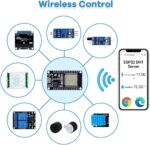
ESP32 IoT Starter Kit puts Wi-Fi and Bluetooth at the centre of every
project from the very beginning. With the ESP32, students do not just learn to blink
LEDs and read sensors — they learn to publish sensor data to cloud dashboards, control
relays remotely from a smartphone, send temperature alerts via email, and build the kind
of connected, intelligent devices that define modern electronics engineering. This is not
a starter kit that you will outgrow in a week — it is a platform that grows with you
from your first LED project all the way to production-ready IoT prototypes.
Key Features of the ESP32 IoT Starter Kit
1. ESP32 NodeMCU – Dual-Core Wi-Fi and Bluetooth Microcontroller
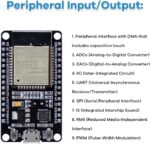
The heart of the ESP32 IoT Starter Kit is the ESP32 NodeMCU development
board — Espressif’s most powerful and popular IoT microcontroller. It features a dual-core
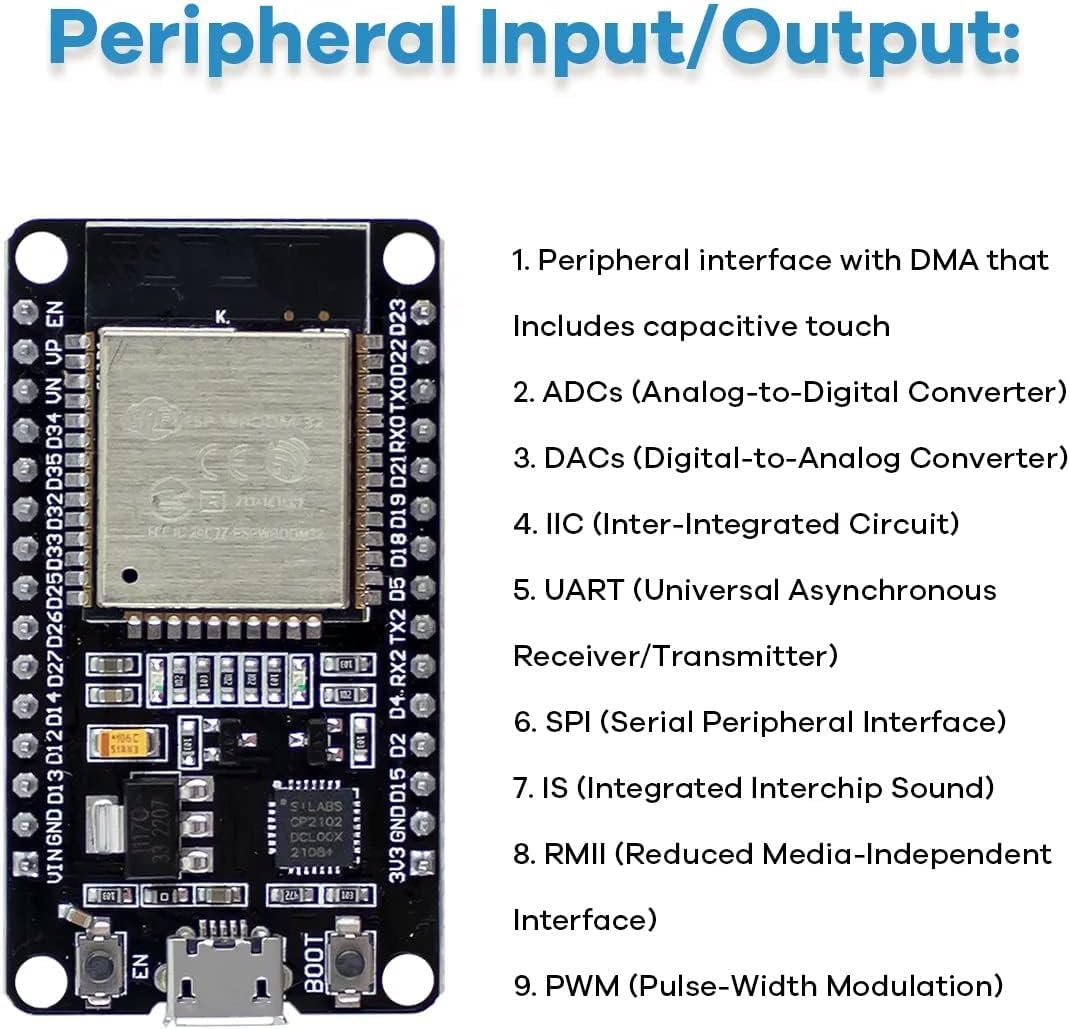
240MHz Xtensa LX6 processor, 520KB SRAM, built-in 2.4GHz Wi-Fi (802.11 b/g/n), Bluetooth
Classic and BLE 4.2, 34 programmable GPIO pins, multiple hardware SPI/I2C/UART/I2S
interfaces, built-in ADC and DAC, and a hall effect sensor and temperature sensor on-chip.
The ESP32 is fully programmable via the Arduino IDE, MicroPython, or ESP-IDF, making it
accessible for complete beginners while offering the depth and performance that professional
IoT developers demand.
2. 0.96-Inch I2C OLED Display – Crisp Real-Time Data Visualisation
The included 0.96-inch I2C OLED display module has a 128×64 pixel resolution and
communicates with the ESP32 using just two wires (SDA and SCL). Its high-contrast white
pixels on a black background are clearly visible in all lighting conditions without any
backlight power consumption. Students can display real-time sensor readings, project names,
scrolling text, animated icons, Wi-Fi status indicators, and custom graphics — turning
their ESP32 IoT Starter Kit projects into polished, presentation-ready
demonstrations rather than raw serial monitor outputs.
3. 2-Channel 5V Relay Module – Real-World Appliance Control
The 2-channel relay module is one of the most powerful learning components in the
ESP32 IoT Starter Kit. It bridges the gap between low-voltage
microcontroller outputs and real-world 230V AC appliances — allowing the ESP32 to switch
lights, fans, pumps, and other electrical devices on and off under program control. With
two independent relay channels, students can build a dual-output smart switch, a
time-scheduled appliance controller, a Wi-Fi-controlled home automation node, or a sensor-
triggered safety cutoff — opening up a world of practical IoT applications that directly
relevant to everyday life.
4. PIR Motion Sensor – Intelligent Presence Detection
The PIR (Passive Infrared) motion sensor detects heat signatures from moving humans and
animals within a range of approximately 3–7 metres. When connected to the ESP32 in the
ESP32 IoT Starter Kit, it enables projects such as motion-triggered
alarms, automatic lights, intruder detection alerts sent over Wi-Fi, occupancy monitoring
for smart building systems, and visitor counting applications. The sensor’s sensitivity
and delay time can be adjusted using the onboard trimmers to suit different deployment
environments.
5. DHT11 Temperature and Humidity Sensor – Weather Monitoring Made Easy
The DHT11 digital temperature and humidity sensor measures ambient temperature from
0°C to 50°C with ±2°C accuracy and relative humidity from 20% to 90% RH. In the context
of the ESP32 IoT Starter Kit, the DHT11 enables students to build weather
stations that display live readings on the OLED, log data to Google Sheets via Wi-Fi,
send humidity alerts to a smartphone app, control a relay-switched fan based on temperature
thresholds, and publish readings to cloud IoT platforms like Blynk, ThingSpeak, or MQTT
brokers.
6. LDR Light Sensor Module – Ambient Light Sensing
The LDR (Light Dependent Resistor) sensor module provides both digital and analog output
to the ESP32, allowing projects to detect whether a room is bright or dark, measure
relative light intensity levels, or trigger automated responses based on lighting conditions.
Common applications with the ESP32 IoT Starter Kit include automatic
night lights that activate at dusk, smart curtain or blind controllers, and solar panel
orientation systems.
7. Infrared (IR) Receiver Module – Remote Control Integration
The IR receiver module allows the ESP32 to receive and decode signals from standard
TV, AC, and set-top box remote controls. This enables students to build projects where
household remote controls are repurposed to control their circuits — changing LED colours,
triggering relays, adjusting display content, or switching robot modes — without any
additional hardware. The IR receiver module teaches students about infrared communication
protocols and introduces them to reverse-engineering commercial remote control signals.
8. RGB LED, Coloured LEDs, and Buzzers – Rich Visual and Audio Feedback
The ESP32 IoT Starter Kit includes a comprehensive set of output
components for visual and audio feedback. The RGB LED (common cathode) allows full-colour
mixing using PWM control on its red, green, and blue channels — enabling projects with
colour-coded status indicators, mood lighting, and visual alerts. Fifteen individual 5mm
LEDs in red, yellow, and green (five of each) are included for multi-LED displays, traffic
light simulators, and indicator arrays. Two piezo buzzers — one active (produces a fixed
tone when powered) and one passive (pitch-controlled via PWM) — enable audio alerts,
doorbells, musical note sequences, and alarm systems.
9. Rotary Potentiometer and Push Buttons – Hands-On User Input
A 10KΩ rotary potentiometer provides smooth analog input to the ESP32’s ADC, enabling
projects with manually adjustable thresholds, volume control, brightness dimming, servo
angle control, and parameter tuning without a screen or keyboard. Six tactile push buttons
with coloured caps provide digital input for menu navigation, game controls, mode
selection, and manual trigger inputs — making ESP32 IoT Starter Kit
projects genuinely interactive and user-controllable.
10. Full-Sized 830-Point MB-102 Breadboard – Build Anything Without Soldering
The full-sized MB-102 830-point breadboard included in the ESP32 IoT Starter
Kit provides ample space to build complex multi-component circuits without any
soldering. Its two power rails and 63 component rows accommodate even the most complex
beginner-to-intermediate circuit layouts — unlike the small 400-point breadboards included
in most competing kits, which run out of space as soon as you add more than two or three
modules. The breadboard is reusable, durable, and compatible with all the components in
this kit.
11. 24 Assorted Resistors and 3 Jumper Wire Bundles
Twenty-four quarter-watt assorted resistors cover all the common resistance values
needed for LED current limiting, voltage dividers, pull-up and pull-down configurations,
and sensor interfacing. Three full bundles of premium jumper wires — male-to-male,
female-to-female, and male-to-female — provide enough connection flexibility to wire
every component in the kit simultaneously without running out of wires mid-project.
ESP32 IoT Starter Kit – Complete Component List
| Category | Component | Quantity |
|---|---|---|
| Main Controller | ESP32 NodeMCU Development Board (Wi-Fi + Bluetooth) | 1× |
| Displays & Modules | 0.96-inch I2C OLED Display Module (128×64) | 1× |
| 2-Channel 5V Relay Module | 1× | |
| Sensors | PIR Motion Sensor Module | 1× |
| DHT11 Temperature & Humidity Sensor Module | 1× | |
| LDR Light Sensor Module (Digital/Analog Output) | 1× | |
| Infrared (IR) Receiver/Sensor Module | 1× | |
| Actuators & Indicators | RGB LED (Common Cathode/Anode) | 1× |
| 5mm LEDs – Red, Yellow, Green (5 each) | 15× | |
| Active/Passive Piezo Buzzers | 2× | |
| Control Elements | Rotary Potentiometer (10KΩ) | 1× |
| Tactile Push Buttons with Coloured Caps | 6× | |
| Passives & Hardware | Assorted Resistors (Quarter-Watt) | 24× |
| Full-Sized MB-102 Breadboard (830 Points) | 1× | |
| Micro-USB Cable (Data & Power) | 1× | |
| Wiring | Premium Jumper Wires (M-M, F-F, M-F bundles) | 3 Bundles |
ESP32 IoT Starter Kit – Technical Specifications
| Feature | Specification |
|---|---|
| Main Controller | ESP32 NodeMCU (Dual-Core 240MHz, 520KB SRAM) |
| Wireless | Wi-Fi 802.11 b/g/n + Bluetooth Classic & BLE 4.2 |
| GPIO Pins | 34 Programmable GPIO (SPI, I2C, UART, I2S, ADC, DAC) |
| Display | 0.96-inch I2C OLED – 128×64 pixels |
| Relay Channels | 2× (5V coil, 230V AC / 10A rated contacts) |
| Temperature Sensor | DHT11 – 0°C to 50°C (±2°C), 20–90% RH |
| Motion Detection | PIR Sensor – 3 to 7 metre range |
| Distance Sensing | LDR Module – Digital + Analog Output |
| IR Communication | IR Receiver – compatible with standard remote controls |
| Breadboard | MB-102 Full-Sized – 830 tie points |
| LED Count | 16× (1 RGB + 15 individual: 5 red, 5 yellow, 5 green) |
| Push Buttons | 6× Tactile with coloured caps |
| Resistors | 24× Assorted quarter-watt |
| Programming | Arduino IDE, MicroPython, ESP-IDF (all free) |
| Power Supply | 5V via Micro-USB (included cable) |
| Soldering Required | No – fully breadboard-based |
| Total Components | 37 components across 8 categories |
| Skill Level | Beginner to Advanced |
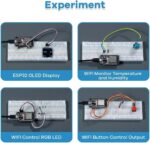
10 Project Ideas for Your ESP32 IoT Starter Kit
Here are just a few of the dozens of projects you can build with the
ESP32 IoT Starter Kit:
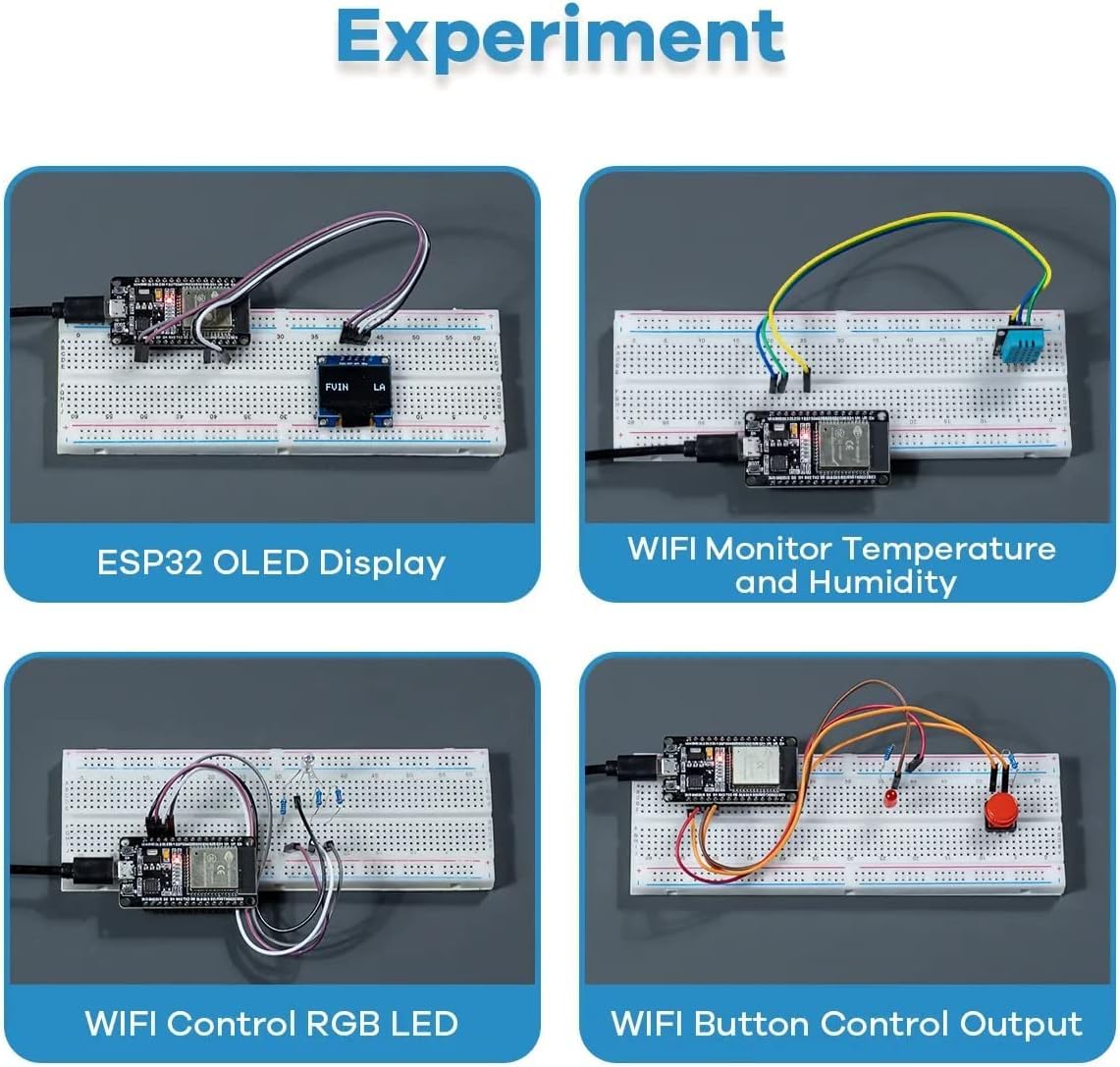
- 🌡️ Wi-Fi Weather Station – Display live temperature and humidity
on the OLED and publish to a cloud dashboard via Wi-Fi - 💡 Smart Home Relay Controller – Control two home appliances
remotely from a smartphone web interface hosted on the ESP32 - 🚨 Motion-Triggered Security Alarm – Use the PIR sensor to
detect intruders and trigger the buzzer and an email notification - 🌈 Bluetooth RGB LED Controller – Control the RGB LED colour
mix in real time from a smartphone Bluetooth terminal - 📺 IR Remote Control Decoder – Decode any TV remote and use
its buttons to control LEDs, relays, or display content - 🎵 ESP32 Digital Piano – Use the push buttons and passive buzzer
to play musical notes and build a mini piano - ☀️ Automatic Night Light – Use the LDR to automatically switch
a relay-controlled light on at dusk and off at dawn - 📊 IoT Data Logger – Log DHT11 and LDR readings to Google Sheets
or ThingSpeak via Wi-Fi at regular intervals - 🎮 Reaction Time Game – Build a multiplayer LED reaction game
using the coloured buttons and 5mm LEDs - 🏠 MQTT Smart Home Node – Connect to Home Assistant or Node-RED
via MQTT for a full smart home automation project
What Skills Will You Learn?
The ESP32 IoT Starter Kit provides a comprehensive hands-on
learning path from basic electronics to connected IoT systems:
- ⚡ ESP32 and Arduino programming – GPIO control, analog reading,
PWM, interrupts, and timers - 📡 Wi-Fi networking – Web servers, HTTP requests, REST APIs,
and cloud platform integration - 🔵 Bluetooth communication – BLE and Classic Bluetooth serial
communication with smartphones - 🖥️ I2C protocol – Communicating with the OLED display and other
I2C peripherals using two wires - 🌡️ Sensor integration – Reading digital and analog sensor data
and making decisions based on it - 🔌 Relay and mains switching – Safely interfacing low-voltage
microcontrollers with high-voltage appliances - 💡 LED and display driving – Current limiting, PWM dimming,
RGB colour mixing, and OLED graphics - 🌐 IoT cloud platforms – Blynk, ThingSpeak, MQTT, and
Google Sheets integration
Who Is the ESP32 IoT Starter Kit Best For?
- ✅ Students (Grade 9 to Engineering) learning electronics,
embedded systems, and IoT from scratch - ✅ Arduino users ready to upgrade to Wi-Fi and Bluetooth
connected projects - ✅ Hobbyists and makers who want to build smart home gadgets
and connected devices - ✅ Teachers and STEM educators setting up IoT labs for
schools and colleges - ✅ Engineering students working on IoT mini-projects and
final year project prototypes - ✅ Professionals upskilling into IoT and embedded systems
development
Order the ESP32 IoT Starter Kit Today
The ESP32 IoT Starter Kit is available now at VirtualPathshala
with fast shipping across India. Every kit is verified before dispatch to ensure all
37 components are present and functional. Add it to your cart today and start building
real connected IoT projects. For complete ESP32 programming documentation, tutorials,
and project guides, visit the
official ESP32 Arduino documentation.
Customer Reviews
Related Products
Bambu Lab P1S Combo 3D Printer with AMS – Enclosed High-Speed Multi-Color & Multi-Material Printer
In stock
Waveshare 10.1″ Capacitive Touch LCD – 1920×1200 High Resolution, IPS Panel, Optical Bonding, HDMI Interface, 6H Hardness, 10-Point Multi-Touch for Raspberry Pi & Android
In stock

Reviews
Clear filtersThere are no reviews yet.