MQ135 Gas Sensor Module – High-Sensitivity Air Quality and Pollution Control Tracking Board
The MQ135 Gas Sensor module is an incredibly versatile, low-overhead, and high-precision environmental analytics board widely deployed across India for indoor air quality monitor networks (IAQ), smart home ventilation systems, and industrial pollution tracking grids. Utilizing a specialized SnO2 (Tin Dioxide) semi-conductive metal oxide layer inside a micro-heating element, the MQ135 Gas Sensor measures ambient concentrations of harmful airborne compounds. In clean fresh air, the material’s electrical conductivity remains low; as dangerous pollutants accumulate, the sensing film’s resistance drops sharply, giving microcontrollers an immediate indicator of ambient air hazards.
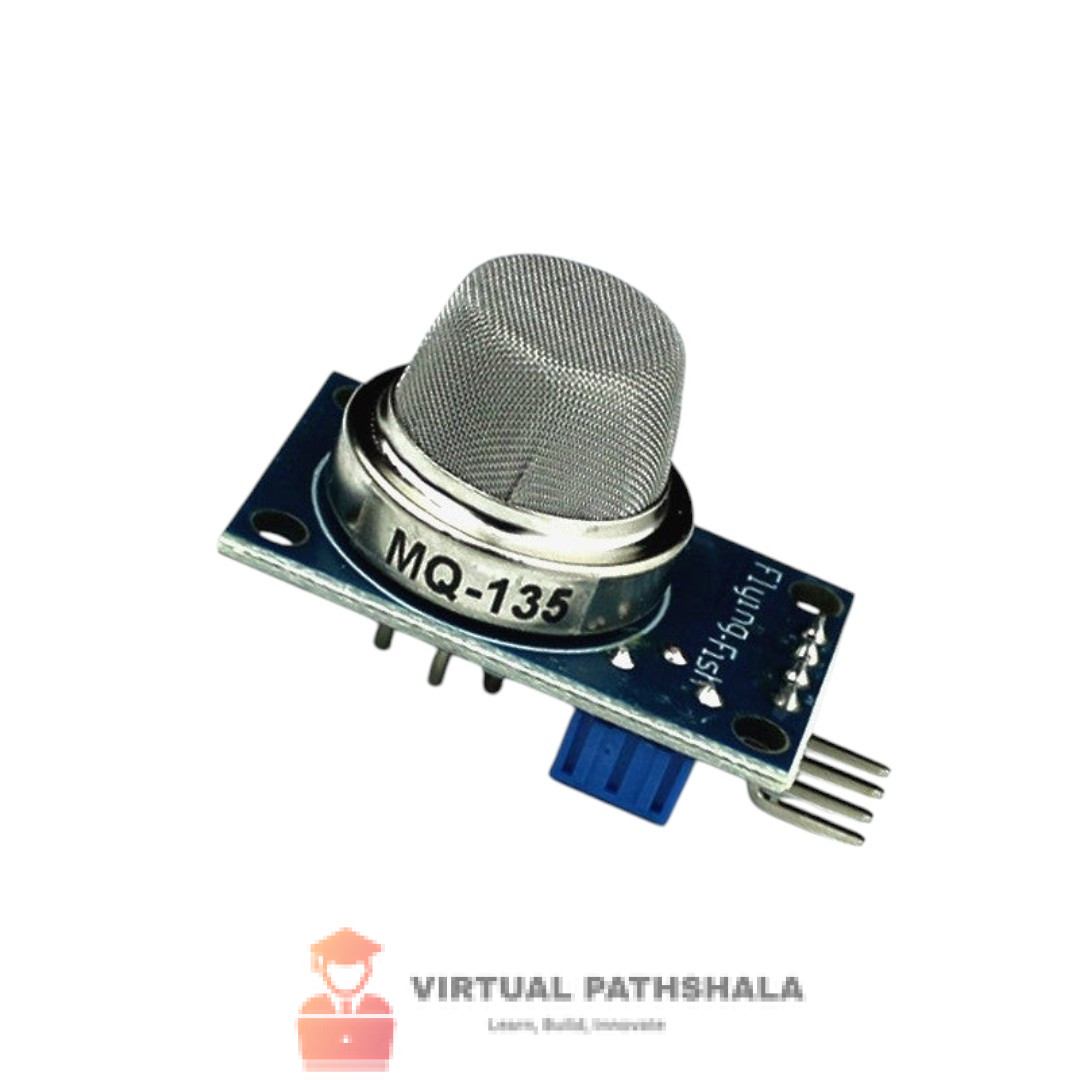
This premium tracking kit features an upgraded circular steel mesh enclosure housing the core heater element, which protects the internal layout from external dust particles while ensuring optimal natural air convection across the chemical sensing paths. The accompanying breakout PCB integrates an LM393 voltage comparator chip, providing both a smooth analog voltage curve for precise PPM calculations and a hardware-debounced digital switching line. Build a comprehensive atmospheric health logging node by combining this air-quality monitor with our collection of I2C LCD Display Modules and highly stable Microcontroller Interface Boards at VirtualPathshala.
Why Choose This Multi-Gas MQ135 Sensor Over Basic Air Sniffers?
Unlike single-purpose detection modules that track only one specific compound, the MQ135 Gas Sensor features an expansive detection spectrum. Its engineered metal-oxide blend provides exceptional sensitivity to multiple prominent atmospheric hazards, including Ammonia ($NH_3$), Benzene ($C_6H_6$), Alcohol vapor, smoke particulates, and Carbon Dioxide ($CO_2$). This multi-gas profiling profile makes it an indispensable, low-overhead addition to smart ventilation ducts, localized laboratory tracking arrays, and DIY air purifiers.
Key Features of the MQ135 Gas Sensor Module
1. Dual Output Modality (Analog & Digital Signals)
This tracking module easily supports diverse software architectures by passing two distinct input signal choices simultaneously from its 4-pin connector block:
- 📊 Analog Output (AO): Generates a real-time varying voltage curve from 0V up to VCC. The output voltage rises in direct proportion to how thick the pollutant gas concentration grows, enabling accurate parts-per-million (PPM) estimations.
- 🔌 Digital Output (DO): Delivers a clean binary TTL signal (0 and 1). Managed directly by the onboard LM393 comparator chip, it stays HIGH when the air is clean and snaps LOW when your ambient pollution safety limits are breached.
2. Onboard Threshold Adjusting Potentiometer
Calibrating your local air hazard threshold requires no complicated code changes or variable adjustment steps. The active driver board houses a high-precision blue potentiometer screw dial. Turning this screw changes the internal reference threshold on the LM393 chip, letting you calibrate the digital output pin to trigger precisely based on custom room safety requirements.
3. Comprehensive 3.3V to 5V Microcontroller Compatibility
Operating efficiently within standard low-voltage DC logic constraints, this module connects smoothly to all major development platforms without requiring active level conversion components:
- ✅ Arduino Uno / Nano / Mega links – Direct 5V power connection with standard analog-to-digital (ADC) pin tracking
- ✅ ESP32 & ESP8266 NodeMCU boards – 3.3V low-voltage operation for cloud-connected WiFi logging rigs
- ✅ Raspberry Pi Single-Board Computers – Clean interface with standard 3.3V GPIO input lines for digital threshold switches
4. Heavy-Duty Steel Mesh Protective Dome
The specialized core component is wrapped inside a double-layer fine stainless steel wire mesh cover. This structure serves two crucial engineering roles: it prevents physical wind gusts from causing thermal instability along the internal micro-heater core, and it serves as an explosion-proof mesh barrier that isolates the hot internal core from ignition risks if volatile vapors build up outside.
5. Built-In Dual Visual Status Diagnostic LEDs
Troubleshooting out in the field is quick and straightforward thanks to the dual surface-mount onboard LEDs. The red power light illuminates continuously to show that a clean input voltage line is present. The green digital status indicator turns on automatically the exact millisecond gas concentrations trigger your preset threshold, allowing for quick visual testing without looking at a computer screen.
MQ135 Gas Sensor Module – Full Technical Specifications
| Sensor System Performance Metric |
Technical Specification Parameters |
| Electrical Characteristics |
|
| System Working Voltage Range |
5.0V DC Regulated Supply Line (Required for Heater) |
| Active Heater Resistance ($R_H$) |
$31\Omega \pm 3\Omega$ at Room Temperature |
| Active Operating Current Draw |
~150 mA to 180 mA Continuous (Due to Internal Heater) |
| Integrated Voltage Comparator IC |
Onboard High-Precision LM393 Core Chipset |
| Output Signal Protocols |
Dual Line: Analog Voltage Level & Digital TTL Binary Status |
| Digital Output Current Drive Capacity |
> 15 mA Clean Current Sink/Source |
| Sensing Core Performance |
|
| Target Gas Sensitivities Spectrum |
Ammonia ($NH_3$), Benzene ($C_6H_6$), Alcohol, Smoke, Carbon Dioxide ($CO_2$) |
| Standard Gas Detection Range Scale |
10 PPM to 300 PPM (Ammonia/Benzene) | 10 PPM to 1000 PPM (CO2) |
| Sensing Film Material Type |
SnO2 (Tin Dioxide) Semi-Conductive Layer |
| Clean Air Baseline State Output |
Digital Pin: HIGH | Analog Pin: Low Base Voltage (~0.5V – 1.2V) |
| Gas Triggered Dense Polluted State |
Digital Pin: LOW | Analog Pin: Closes toward VCC Max |
| Physical Setup Measurements |
|
| Overall Module Board Size |
32.0 × 20.0 × 22.0 mm Processing Unit |
| Connecting Pin Header Array |
4-Pins Out (VCC, GND, DO, AO out of 2.54mm Pitch) |
| Net Sensor Kit Weight |
7.5 Grams Total Footprint Build Weight |
What Is Safely Included inside the Package
- ✅ 1× MQ-135 Gas Sensor Breakout Module (Blue PCB Version)
Frequently Asked Questions – MQ135 Gas Sensor Module
Why does the MQ135 Gas Sensor get warm or hot to the touch during operation?
This is completely normal and intentional by design. The **MQ135 Gas Sensor** relies on an internal nichrome heating wire wrapped around a small ceramic core to bring the SnO2 chemical sensing layer up to its optimal working temperature (around 300°C–400°C). This high heat layer is required for the gas molecules to interact chemically with the tin dioxide film, so the module will draw a continuous 150mA–180mA and feel warm while powered up.
What is the “Burn-In Period” (Preheating Time) and why is it necessary?
When you first power up a brand-new MQ135 module out of the box, it requires an initial burn-in period of 24 to 48 hours connected to a stable 5V power line. This extended preheating phase bakes off trace manufacturing residues, chemical storage coatings, and ambient moisture that coat the SnO2 layer. Skipping this phase will result in erratic, drifting baseline analog values. For daily use, allow the sensor to preheat for roughly 2 to 5 minutes before reading data to let the baseline stabilize.
Can this module measure the exact parts-per-million (PPM) of a single gas accurately?
Because the metal-oxide film reacts to multiple gases simultaneously, the raw analog output reflects a combined pollution index rather than isolated individual gas weights. To get a close estimate for a specific target gas like $CO_2$, your software needs to implement a math model that uses the sensor’s baseline resistance ($R_O$) in clean air along with the log-log sensitivity curves provided in the factory datasheet, ideally paired with a temperature/humidity sensor like a DHT22 to adjust for environmental drift.
Order Your MQ135 Gas Sensor Module Online Today
Build your automated indoor air quality logs, protect your household with automated smart ventilation fans, or add hazardous gas alarms to your office safety grids with ease. Supplied across all domestic Indian locations with fast, reliable express shipping options from VirtualPathshala. For official circuit schematics, calibration software libraries, and multi-sensor dashboard codes, check our matching catalog items or contact our tech support team.







Reviews
Clear filtersThere are no reviews yet.